

law of motion
 3
3.9
3
3.9

- noun
- /lɔː ʌv ˈmoʊʃən/
- Specialized
- Newton's first law of motion states that an object at rest will remain at rest unless acted upon by a force.
- Newton's laws of motion
- the three laws of motion
- the third law of motion
Loading YouTube…
Watch on YouTubeYou clearly see the physical laws of motion.
- You clearly see the physical laws of motion.
- It's a fundamental principle of physics and is described in Newton's law of motion.
- Motion of atoms and motion of particles and motion of objects is based on laws of motion by Newton.
- That goes all the way back to Newton, in fact, with this idea that we can have a fixed law of motion and which exists sort of it's given to you.
- That is Newton's third law of motion in physics, which says everything that goes out is coming back.
Examples
-
With unusual enthusiasm, he describes to his pupils the beauty of Newton's three laws of motion.
Fiction book (1994) -
Unlike his first and third laws, Newton's second law of motion is an equation: F = ma.
Academic text (2004) -
It's called the law of motion of the system.
-
In truth, it was such a small thing... but how could he have forgotten the basic laws of motion?
Fiction book (1990) -
Physics problems can be designed that incorporate the laws of motion involved in monster truck events.
Academic text (2013) -
Newton's first law of motion.
-
So Newton's laws of motion are involved in all stages of this exciting, thrilling, super fast, high energy sport.
-
But armed with Newton's laws of motion, they could describe the relations among force, mass, and acceleration under all conditions.
Academic text (2004) -
Isaac Newton's three laws of motion are staring you right in the face every time you go ice skating.
-
That's why we've been able to unravel the secrets of the solar system, complements of the laws of motion of Isaac Newton.
Synonyms
 2
3.8
2
3.8
Three basic rules that explain how pushes and pulls change the motion of objects
 1
3.5
1
3.5
Three basic rules that explain how objects move and push each other in physics
 1
4.1
1
4.1
An object stays still or keeps moving at the same speed and direction unless a force acts on it


 1
4.1
1
4.1
An object stays still or keeps moving at the same speed and direction unless a force acts on it
 1
3.4
1
3.4
A rule that shows how force, mass and acceleration relate
 1
3.9
1
3.9
Every force causes an equal force in the opposite direction
 1
4.2
1
4.2
Every push on an object causes an equal push back in the opposite direction
 1
4.1
1
4.1
Every push or pull makes an equal force in the opposite direction

An object stays still or keeps moving in the same straight line unless a force acts on it
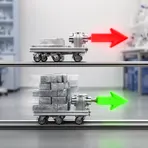
A rule that says how a force makes an object move faster depending on its mass

A rule that a force changes an object's motion more when the force is bigger or the object is lighter
Surface Forms
Morphology
The phrase 'law of motion' is directly compositional: 'law' (a general principle) + 'motion' (movement) yields a principle governing movement, so a learner who knows the constituent words can infer the basic meaning. This construction is conceptually transparent and common across languages (so only domain-specific details like Newton's three laws require further study), making it accessible to a B1 learner.
Etymology
Law of motion comes from the idea of a simple rule about movement. Think of law as a strong 'rule' and motion as 'movement'; Newton wrote clear rules that show how objects move, so the phrase means a basic rule that explains movement.