
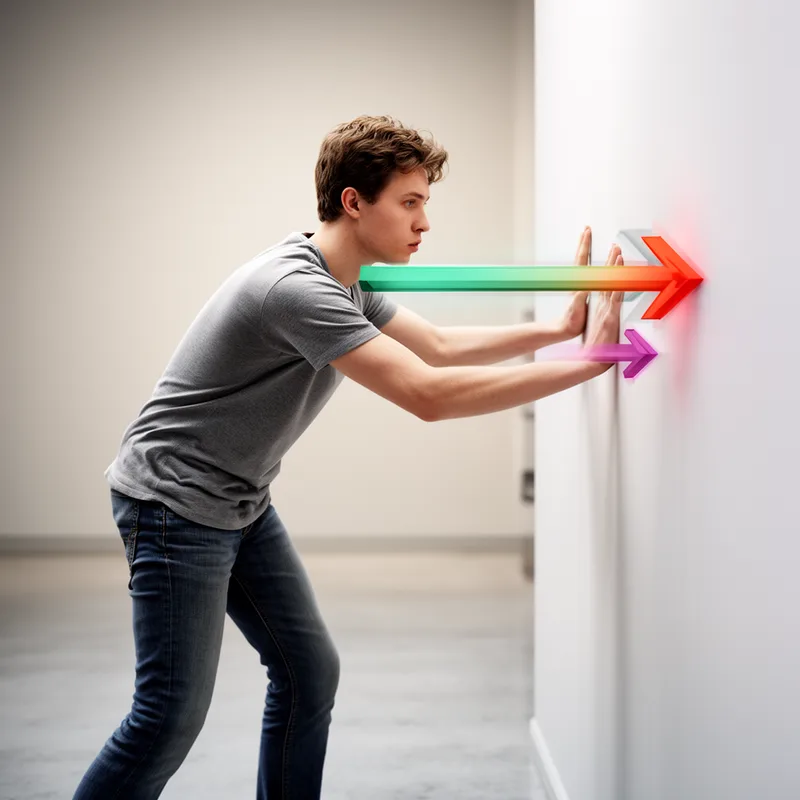
third law of motion


 1
4.2
1
4.2
- noun
- /θɜrd lɔː ʌv ˈmoʊʃən/
- Specialized
- A cannonball propelling forward demonstrates Newton's third law of motion as it pushes the cannon backward.
- Newton's third law of motion
Examples
-
When you jump off a small boat, you can see Newton's third law of motion in action; as you go forward, the boat moves backward.
-
So Newton's third law of motion--
-
Criticism is like Newton's third law of motion: for every action, there is an equal and opposite reaction.
Academic text (1992) -
Newton's third law of motion (i.e., for every action there is an equal and opposite reaction) says that the thumb's force transmitted to one blade is opposed by the fingers' force transmitted to the other blade, converging at the paper to shear it.
Academic text (2011) -
In a game of pool, striking the cue ball causes it to roll while the cue stick reacts, exemplifying Newton's third law of motion.
Synonyms
 1
4.1
1
4.1
When one object pushes another, the other object pushes back equally
 1
3.9
1
3.9
Every force causes an equal force in the opposite direction
 1
4.1
1
4.1
Every push or pull makes an equal force in the opposite direction
Surface Forms
Morphology
The phrase is compositionally transparent: ‘third’ (ordinal) + ‘law’ (a scientific/general rule) + ‘of motion’ (about movement) clearly signals a specific, numbered scientific law concerning motion, so a B1 learner who knows the words will understand it names a law about motion. The precise content of that law (equal and opposite reaction) is specialized knowledge not recoverable from the constituents, but the referential meaning is predictable from the parts.
Etymology
The third law of motion comes from watching how pushes always come in pairs: when you push something, it pushes back. So 'for every action there is an equal and opposite reaction', which is why the law explains that forces always act in pairs.