
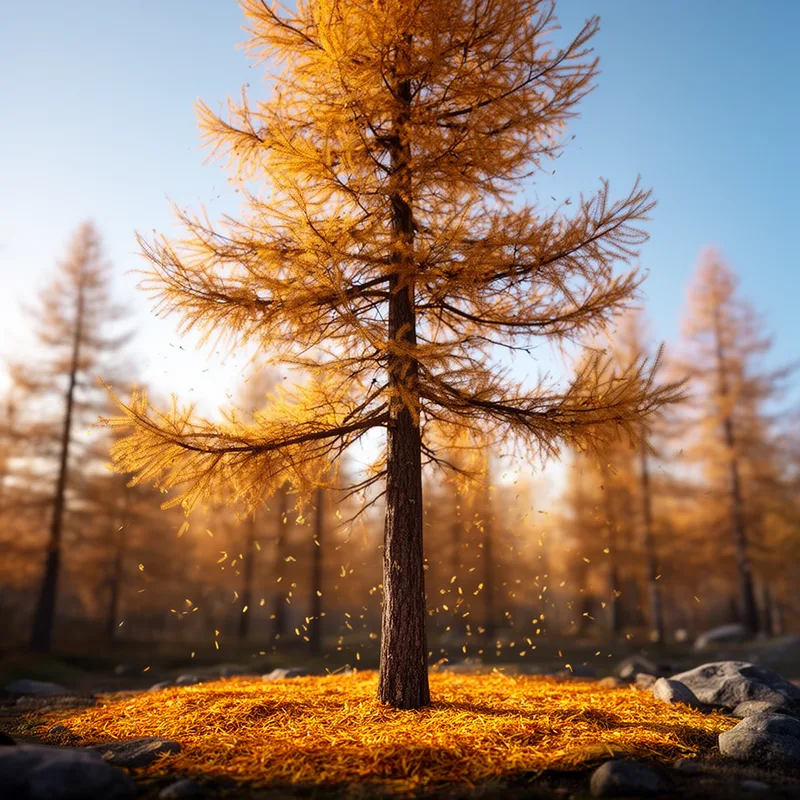
larch tree


 1
6.0
1
6.0
- noun
- /lɑrtʃ tri/
 :
alerce
:
alerce
- Many carpenter bees are attracted to the wood of a larch tree due to its durability.
Examples
-
Heather Alexander twists a tree corer into a dead larch tree in a burned forest near Cherskiy, Republic of Sakha, Russia.
Academic text (2011) -
In the paper I cite above, they found that older LARCH trees are more responsive to climate.
Blog text (17) -
They found that older Larch trees are more responsive to climate.
Blog text (17) -
Remember that in a Craig Loehle post above, he had an excerpt from a paper stating that older larch trees are more sensitive to climate changes and young ones are relatively insensitive.
Blog text (17) -
Tom, Tom, Tom, by your hypothesis and Craig Loehle's excerpt (they found that older LARCH trees are more responsive to climate), taking out the shorter cores leaves those most likely to respond to climate in the current time and past.
Blog text (17) -
Near where I work, there are a lot of larch trees mixed in with pines and birch on the side of a mountain (well, what we call a mountain, you call a hill out west LOL), and the yellows were phenomenal this year.
Blog text (15) -
The larch tree loses its needle-like leaves every autumn, making it unique among conifers.
-
In the forest, the larch tree stands out with its vibrant yellow foliage during fall.
Synonyms
 1
6.3
1
6.3
A tree with thin needle leaves that turn yellow and fall each autumn
How Tall

Surface Forms
Morphology
The meaning 'a tree of the genus Larix' is directly and compositionally derived from 'larch' (a type of tree) combined with 'tree' (a perennial woody plant). This noun + noun naming pattern is a straightforward descriptive compound found across languages, so a B1 learner who knows both constituents will readily understand the MWE.
Etymology
Larch tree may come from the old Latin word 'larix', once used for this kind of tree. People noticed that a larch is a tree with needle-like leaves that turns golden and 'loses its needles' in autumn, so the name points to its most famous feature.