
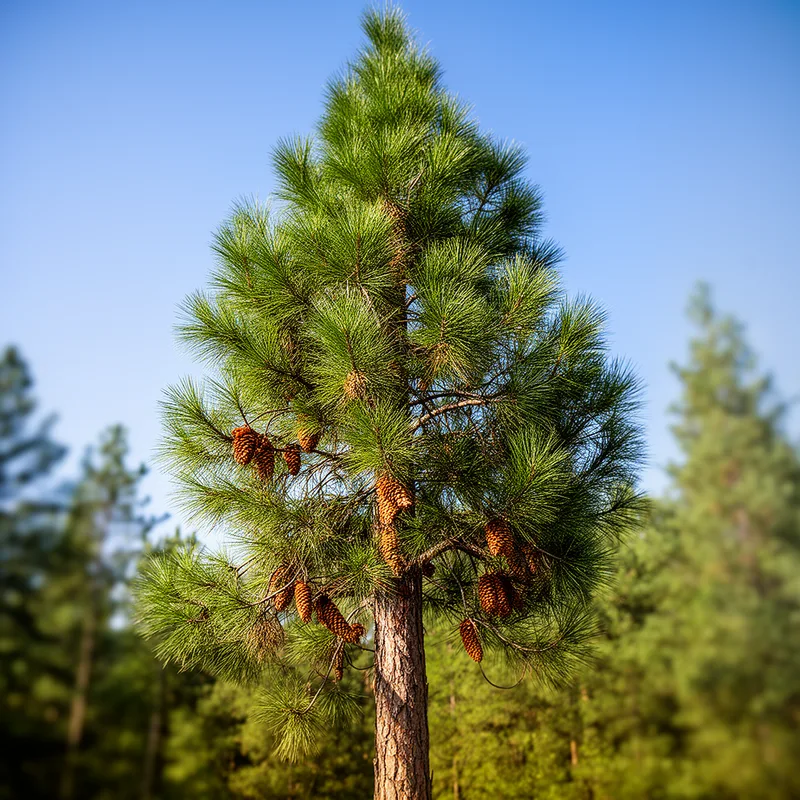
pine tree
 25
1.0
25
1.0

- noun
- /paɪn tri/
- The tall pine tree provided shade during our picnic in the park.
- green pine trees
Loading YouTube…
Watch on YouTubeWe've ordered some wool stickers, which are like pine trees.
- We've ordered some wool stickers, which are like pine trees.
- Well, we were going in strafe and went too low and hooked his skid on a pine tree and crashed.
- I think that'll give it a lot of like that tufty, kind of WAVY look that the big boughs of pine trees have.
- And then I've rolled flat another little piece of blue fondant and I cut out this little pine tree right for the middle and trace it out, cut it out.
- I just turned around and I'm back away, walk back out of the forest, crawled out and I got to the the pine trees where the fence was crunched.
Examples
-
The air was clean and smelled of the pine trees that blew in the early-morning wind.
Fiction book (1993) -
Along the winding mountain roads, we encounter roadblocks of massive pine trees, hastily chopped and placed in our path.
Academic text (2004) -
And now these pine trees smell so strong.
-
But we recently had two big pine trees removed from this area here.
-
And Oh my gosh, can you see that big pine tree back there?
-
We walked through the dark woods and felt the tall, silent pine trees watching us.
Fiction book (1993) -
On the left, a tall pine tree with spreading branches framed the view.
Academic text (2006) -
Sagebrush and an occasional pine tree were scattered across the land.
Fiction book (1991) -
I wandered through the campus of brick buildings, pine trees, and green lawns and found the library.
Academic text (2007) -
When it's cold and wet, the pine tree seeds just can't disperse on the wind and plant new trees very successfully.
Synonyms
 130
1.0
130
1.0
An evergreen tree with long needle leaves and cones

A tree in the Pinus group that has long needles and cones
How Hard


Surface Forms
Morphology
The meaning 'an evergreen conifer of the genus Pinus' is directly derivable from combining 'pine' (a type of conifer) and 'tree' (a tall perennial plant). This is a straightforward noun–noun compound that specifies a subtype and follows common compositional patterns found across languages, so a B1 learner who knows both constituents will understand it.
Etymology
Pine tree comes from a simple picture: people saw a tall evergreen with long, needle-like leaves and hard cones and called that kind of tree a pine, so the name joined pine and tree. That's why Pine tree now means an 'evergreen' with needle-shaped leaves and cones.