
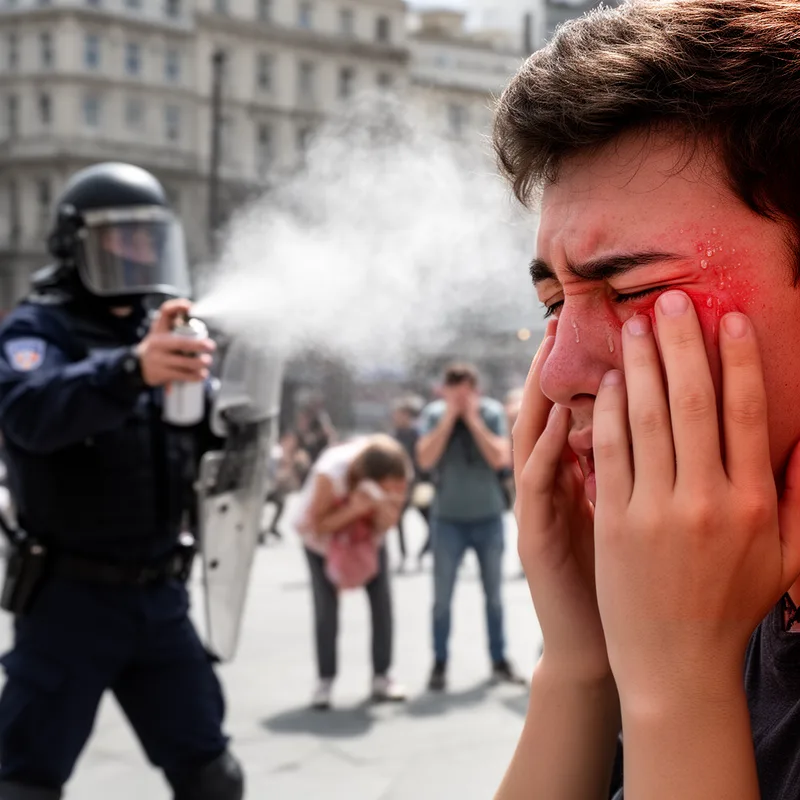
lachrymator
- noun
- /ˈlækrɪˌmeɪtər/
- UK
- Police deployed a lachrymator to disperse the demonstrators in the square.
Examples
-
The military uses a lachrymator as a non-lethal crowd control agent.
-
The police used a lachrymator to disperse the crowd.
-
Exposure to the lachrymator caused everyone's eyes to water uncontrollably.
-
Many protesters were affected by the lachrymator during the demonstration.
-
The police used a lachrymator to disperse the crowd during the protest.
-
In crowd control situations, lachrymators can effectively produce tears without causing lasting harm.
-
The lachrymator released a cloud of gas that made everyone in the area sob uncontrollably.
Synonyms

 57
4.4
57
4.4

A chemical that makes eyes water and people cough to make crowds move away
 15
3.7
15
3.7
A gas that makes people's eyes burn and makes them cry, used by police to break up crowds

 1
9.5
1
9.5
A gas that makes the eyes water and sting
A gas that burns the eyes and makes people cry, used by police to break up crowds
How Irritating

Surface Forms
Morphology
lachrymator = lachrym + ator
The element 'lachrym-' is a learned combining form for 'tear' that is not a productive or familiar English base for most learners, so the meaning of 'lachrymator' is not derivable by a typical B1 learner from its parts.
Etymology
Lachrymator comes from the Latin root lacrima meaning 'tear' and the ending -ator meaning 'that which causes'. So a lachrymator is something often used as a gas that makes your eyes water, which explains its modern use for chemicals that cause tears.