
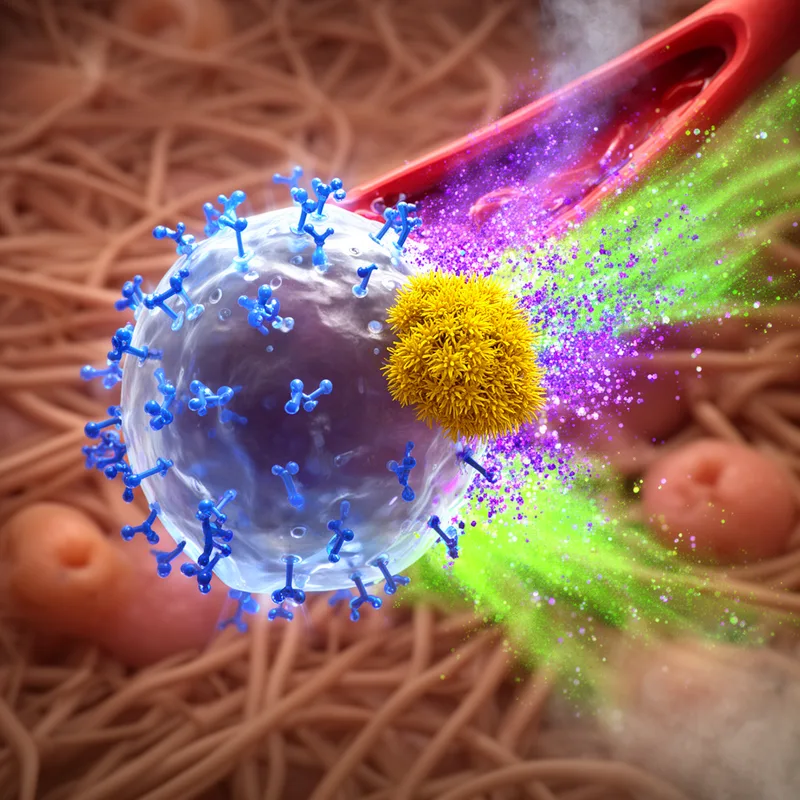
labrocyte
- noun
- /ˈlæbrəˌsaɪt/
- Archaic
- Labrocytes release histamine during allergic reactions, which helps to cause inflammation.
Examples
-
The doctor explained that inflammation was partly caused by overactive labrocytes.
-
The labrocyte plays a crucial role in the immune response.
-
Labrocytes release histamine during the body's allergic response.
-
Research into labrocyte functions has advanced treatments for allergic conditions.
-
Many labrocytes are found in connective tissue.
-
In response to an injury, labrocytes can release heparin to prevent blood clotting.
-
The presence of labrocytes in connective tissue is essential for managing allergic responses.
Synonyms
 1
5.6
1
5.6

A large cell in body tissue that releases chemicals during allergic reactions and inflammation

A large cell in body tissue that releases chemicals like histamine during allergies, causing itching and swelling
Surface Forms
Morphology
labrocyte = labro + cyte
Though '-cyte' is a productive biomedical combining form meaning 'cell', 'labro' is not a recognizable standalone English base and the full term is a technical biomedical coinage, so an average learner cannot reliably derive the meaning.
Etymology
Labrocyte breaks into labro- and -cyte, and -cyte means 'cell', as in erythrocyte, 'red blood cell', or leukocyte, 'white blood cell'. One helpful way to remember labro- is to think of a 'lip' that opens to let things out, so a labrocyte is a cell that releases chemicals like histamine during an allergic reaction or inflammation.