
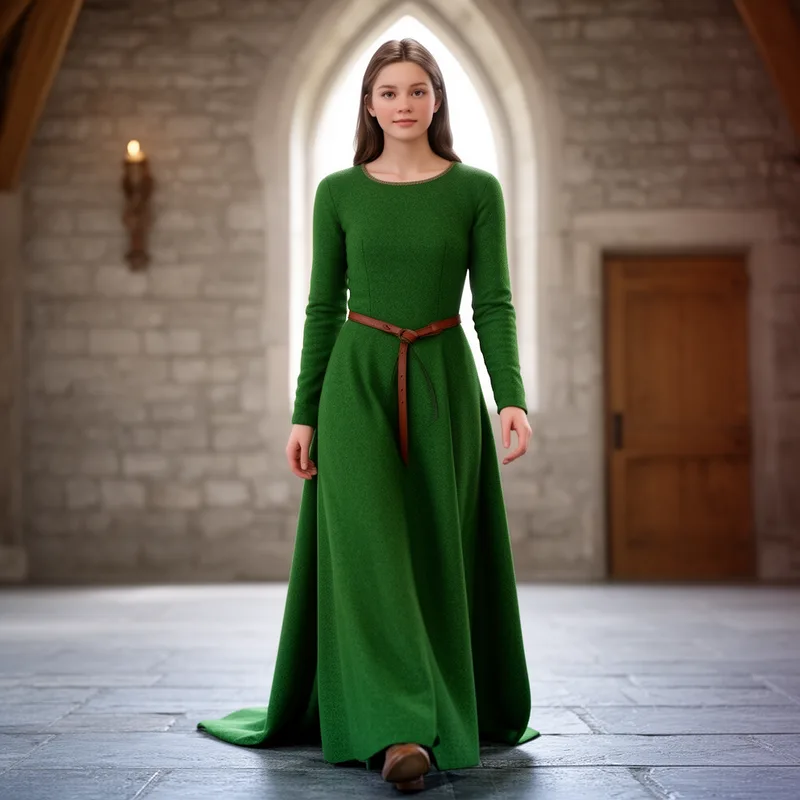
kirtle


 1
9.9
- noun
- /ˈkɜːrtəl/
- Archaic
- During medieval festivals, it was common to see participants dressed in colorful kirtles to celebrate the occasion.
Examples
-
I lay my unworthy head down upon the cruel block and kiss the hem of Death's own kirtle if such sacrifice might purchase me but a single hyaline drop of compassion's own sweet dew from the matchless lights of your regal eye.
Fiction book (1993) -
"Where shall I begin?" Lifting her kirtle to gift him with a luscious view of her bare bottom, Piety moved to straddle his waist.
Fiction book (2002) -
Fayth patted the pocket sewn into the underside of her kirtle.
Fiction book (2002) -
She looked more like a beardless lad in a kirtle than a lass overripe for marriage.
Fiction book (2002) -
She peeled back a portion of her kirtle to expose the curvaceous swell of her well-rounded bosom.
Fiction book (2002) -
Joining her at the window, I could see a crowd of folk dressed in church-going garb of gown, kirtle, coat, and bonnet, led by the stocky figure of Father Bain, the priest who served both village and castle.
Fiction book (1991) -
In the Renaissance, women often wore a kirtle underneath their gowns for added warmth.
-
She admired the intricate embroidery on the kirtle that her grandmother had made decades ago.
Synonyms
 2
7.3
A long loose robe worn by religious people like monks or priests

A loose shirt worn under armor or other clothes in the Middle Ages
How Formal

Surface Forms
Etymology
The word kirtle comes from an old word for a simple 'tunic' or 'dress' and is related to the German word Kittel, which means 'smock'. So a kirtle was originally a long, loose dress people wore in the Middle Ages, and the word still names that kind of garment.