
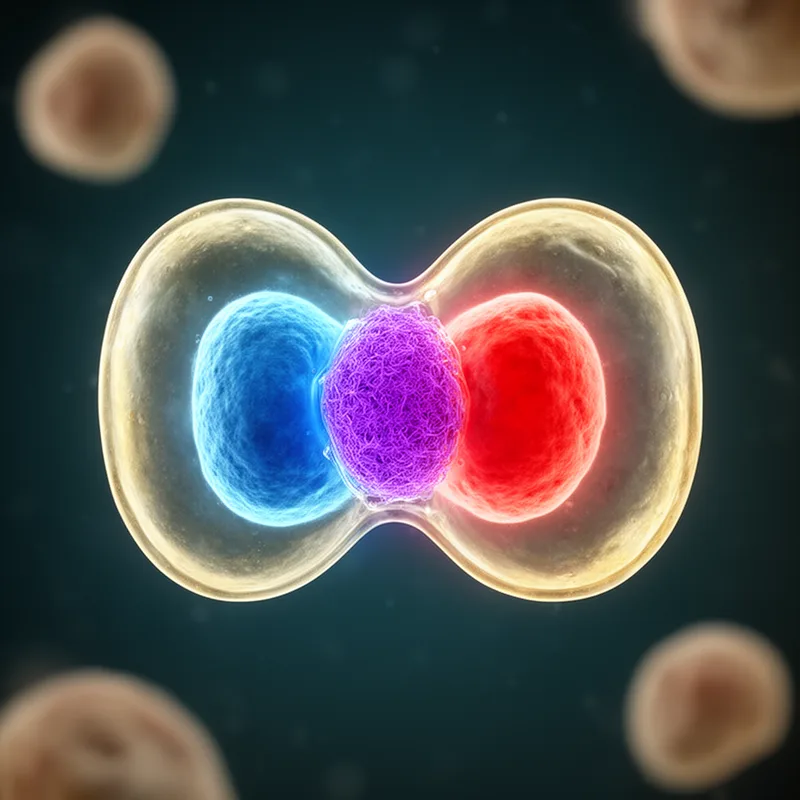
karyogamy
- noun
- /ˌkɛəriˈɒɡəmi/
- Specialized
- The process of karyogamy is essential for the sexual reproduction of protists.
Examples
-
The process of karyogamy occurs when the nuclei of two gametes fuse to create a single nucleus.
-
Expression of OsWEE1 in rice zygotes at 6 h after gamete fusion is consistent with the putative cell cycle of the zygote, in which karyogamy is completed and DNA replication would start.
Academic text (2018) -
In many fungi, karyogamy is a crucial step that leads to the formation of a diploid organism.
Synonyms

Two sex cells, like an egg or sperm, join to make a new cell with genes from both parents
Surface Forms
Morphology
karyogamy = karyo + gamy
The elements are specialized Greek combining forms ('karyo-' and '-gamy') found mainly in technical biology vocabulary, so an average B1 learner cannot infer the meaning from common English base words.
Etymology
The word karyogamy comes from Greek parts karyo- meaning 'kernel' or 'nucleus' and -gamy from gamos meaning 'marriage'. So karyogamy is like a 'marriage of nuclei', two cell nuclei joining to make one, which is exactly the process the word describes.

