
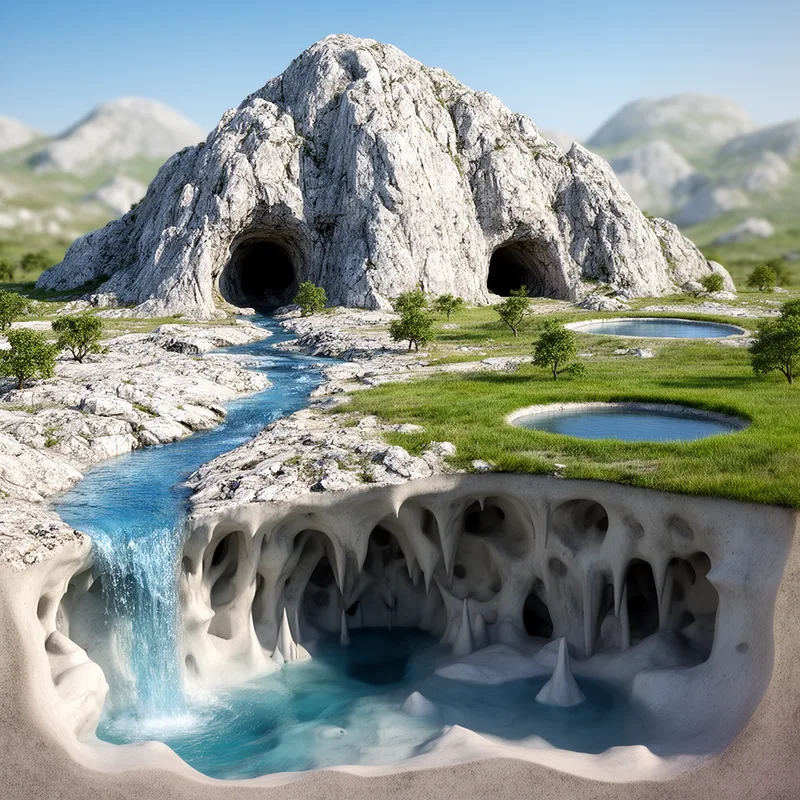
karstic


 1
9.6
- adjective
- /ˈkɑrstɪk/
- Specialized
- Chunchucmil lies in a flat, karstic plain about 45 kilometers southwest of the Chicxulub bolide impact structure, a crater created by a meteorite that struck Earth 65 million years ago (Perry and others 1995).
Examples
-
Life in these karstic polje (fields) is an unremitting struggle against a difficult environment of poor soils and marginal rainfall (Singleton 1985; Vukonic 1992).
Academic text (1997) -
The Maya Biosphere Project paper makes strong claims about soils: "Most of the land in the Biosphere has low-nutrient, karstic soils with little or no topsoil, poor drainage, and fragile structure."
Academic text (1998) -
It is one of the most densely karstic areas in the world, making it a choice area for recreational caving and scientific research.
Blog text (8) -
Jia's paleontological detective work took him to southernmost Guangxi, a karstic, or eroded limestone, region of great rock towers riddled with caves.
Academic text (1991) -
The potential exists for high and spatially extensive nitrate contamination in this karstic area, yet water-quality analyses revealed only moderate levels of nitrate in the groundwater.
Academic text (2000) -
The region is known for its unique karstic features, including sinkholes and limestone caves.
-
Many hiking trails in the park wind through its stunning karstic landscape filled with rocky outcrops.
-
Geologists study karstic formations to understand the effects of water erosion on limestone over time.
Synonyms
 1
8.6
Relating to land with caves, sinkholes, and underground rivers formed when water slowly wears away rock
Surface Forms
Morphology
Etymology
The word karstic comes from the name of the Kras plateau in Slovenia, an area famous for caves and sinkholes. So, karstic describes land where water slowly 'eats away' limestone, making caves, sinkholes, and underground rivers.