
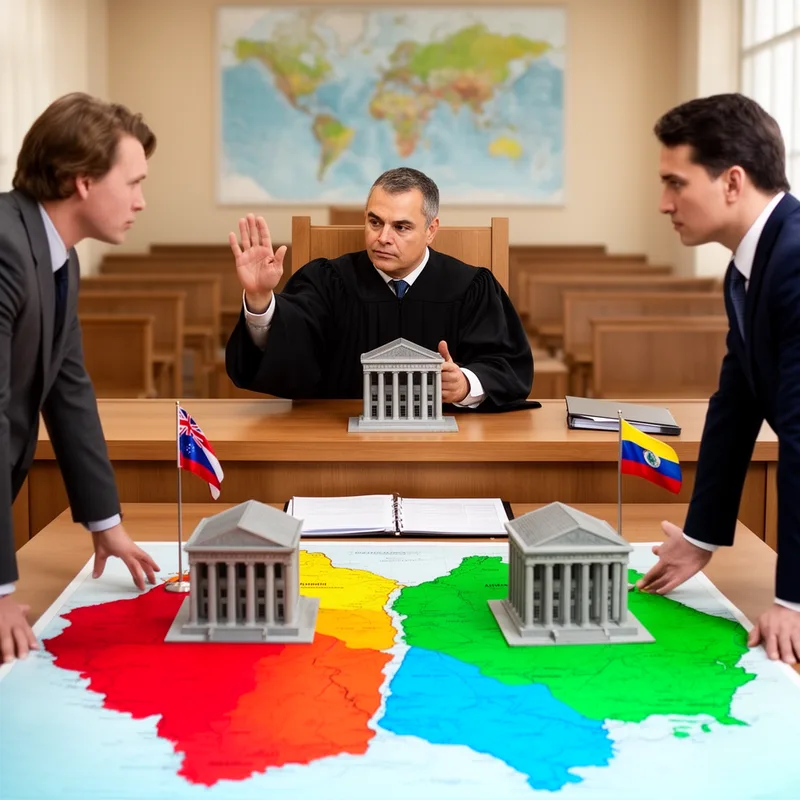
jurisdictionally


 1
8.9
- adverb
- /ˌdʒʊrɪsˈdɪkʃənəli/
- Formal
- Thus, the federal law could contain—and warrant the application of—a jurisdictionally limited capital federal child rape statute.
Examples
-
Jurisdictionally, the FMCA and FTA generally apply to conduct by a person outside of New Zealand if they are supplying services to persons in New Zealand.
Academic text (2018) -
So jurisdictionally, this is...
-
Going forward, the First Ministers' Conference could be an important forum for dialogue and policy coordination on the jurisdictionally ambiguous issue of how the interprovincial externalities of natural-resource development can best be managed.
Academic text (2017) -
As noted, at the time Amchem and Ortiz were decided, federal courts were jurisdictionally challenged with regard to mass tort class actions, and relatedly, the reverse auction was the most glaring ethical challenge of the day.
Academic text (2017) -
The EEZ is really a zone set up in the 1982 UNCLOS to stop countries like Chile, etc., from declaring a 200-mile limit of "territorial sea," which, jurisdictionally, carries with it more of a coastal state's authority due to its more complete sovereignty over the areas of territorial seas.
Academic text (2017) -
The court ruled jurisdictionally on the matter, clarifying which powers belonged to the state.
-
Jurisdictionally, the agreement outlined how disputes would be settled within the designated legal framework.
-
The case was dismissed jurisdictionally because it fell outside the federal court's authority.
How Broad
99
2.9
 157
3.0
- Formal
1
8.9
9
4.0
123
1.4
Surface Forms
Morphology
jurisdictionally = jurisdictional (transparent) = jurisdiction + al + ly
Standard adjective-to-adverb formation from 'jurisdictional' by adding '-ly'.
Etymology
Jurisdictionally comes from parts that mean 'law' and 'to say': juris- means 'law' (as in justice or jury) and -diction means 'to say' (as in dictionary). So to act jurisdictionally is to act in the area where people have the power to decide or apply the law.