
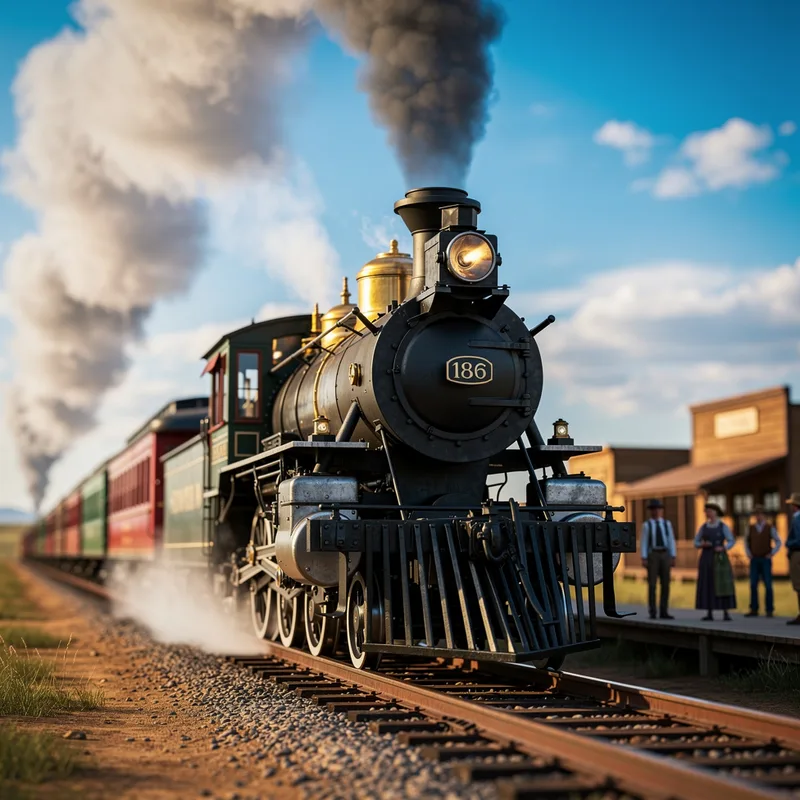
iron horse
 1
9.9
1
9.9

- noun
- /ˈaɪərn hɔrs/
- Archaic
- Indians were supposed to be living; the plow had already broken the plain, and the great iron horse—a train—could be seen crossing the tawny plains of older times in the distance.
- the great iron horse
Examples
-
It is like a great iron horse and is called a locomotive.
Fiction book (1992) -
Medicine Wolf and her people had yet to see one of the dreaded iron horses, but the warriors were growing restless and wary, and already they talked of attacking any railroad builders who came into their prize hunting grounds.
Fiction book (1992) -
Fire up the iron horse, boys.
-
An iron horse comes over the desert.
-
But far less amusing to the Indians... ...was the coming of the steel roadway of the iron horse.
-
They even laid track for that newfangled invention, the iron horse, Which brought a pretty important visitor to Blaine.
-
Everyone expects them to feel like steel coasters, and parks don't want to spend anything on maintenance; hence the success of GGI and the advent of the "iron horse" and "topper track."
Blog text (11) -
In the 19th century, the iron horse revolutionized transportation across the country.
-
They cherished the memory of the iron horse that once brought goods to their quiet town.
-
Children excitedly waved at the passing iron horse as it thundered down the tracks.
Synonyms
 37
4.6
37
4.6
A train engine that pulls rail cars
A large machine on wheels that pulls a train on tracks

A machine on train tracks that pulls or pushes trains
Surface Forms
Morphology
iron + horse
The compound uses a transparent metaphorical logic: 'iron' + 'horse' suggests a horse made of iron or a machine that replaces a horse, so learners can infer a non-literal, mechanical referent. However, identifying the specific referent 'locomotive' (a nineteenth-century train engine) requires cultural/historical knowledge and is not fully predictable from the parts alone, so it is only partially transparent to a B1 learner.
Etymology
Iron horse comes from the early days of steam trains, when people saw a big metal engine made of iron that pulled carriages like a horse. So the phrase came to mean 'a train'.