
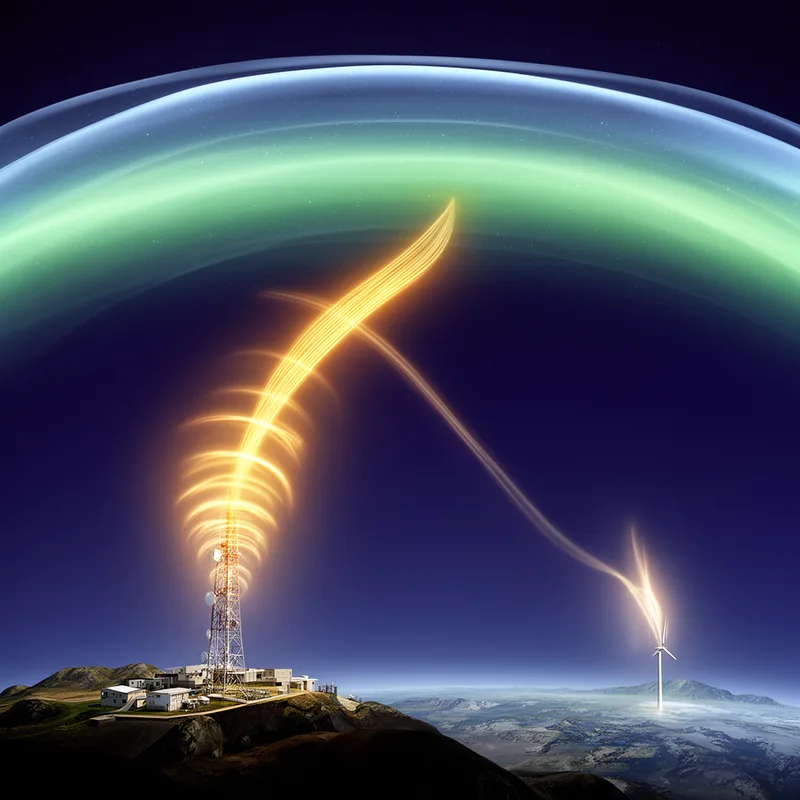
ionospheric wave
- noun
- Specialized
- Radio operators rely on ionospheric waves to transmit signals over long distances.
Examples
-
The strength of an ionospheric wave can vary depending on solar activity.
-
Scientists study ionospheric waves to better understand atmospheric conditions.
-
An ionospheric wave can travel long distances.
-
The ionospheric waves bounced back to the ground.
-
Radio operators rely on ionospheric waves to transmit signals over long distances.
-
Scientists study ionospheric waves to better understand atmospheric conditions.
-
The strength of an ionospheric wave can vary depending on solar activity.
Synonyms

 19
3.2
19
3.2

A wave of invisible energy that sends signals to radios and phones

A radio wave that bounces off the high air layer or a satellite back to the ground to travel far
Surface Forms
Morphology
The compound is compositionally predictable: 'ionospheric' (pertaining to the ionosphere) modifies 'wave', so a learner who knows both constituents can infer it refers to a wave occurring in or associated with the ionosphere. Although the term is technical (often referring to radio waves reflected by the ionosphere), that domain-specific narrowing does not block compositional inference, so the expression is transparently built from its parts.
Etymology
Ionospheric wave comes from the image of a radio wave sent up that 'bounces' off the ionosphere, a high layer of charged air, like a ball hitting a roof and coming back down. That's why it means a radio signal sent into the sky and 'reflected' back to Earth.