
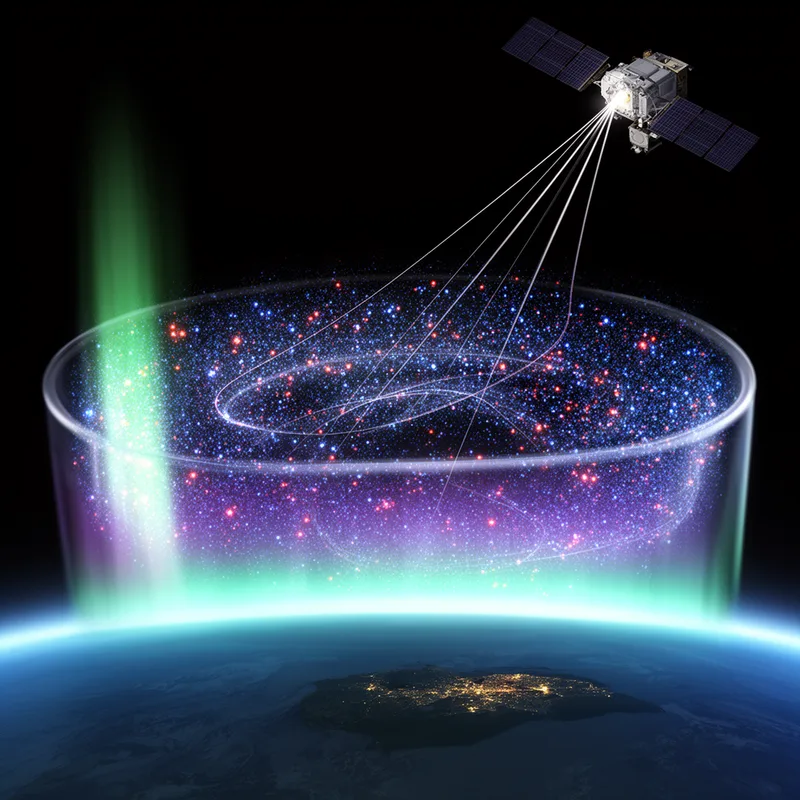
ionospheric
 1
8.1
1
8.1

- adjective
- /ˌaɪəˈnɒsfɪrɪk/
- Specialized
- During solar storms, ionospheric disturbances can disrupt GPS and other navigation systems.
Examples
-
Detailed studies of radio-pulse propagation and ionospheric reflection have localized NBP discharges in the atmosphere with great accuracy:
Academic text (2006) -
We'll use the ionospheric boundary to shake him.
-
Let's face it, we don't know enough about ionospheric flows to work out what is happening in the atmosphere/ionosphere mix that begins above the tropopause.
Blog text (28) -
Solar cycles and eruptions also threaten human safety and national security when ionospheric disturbances interrupt wireless navigation and communication.
Academic text (2006) -
The price for the multi-spacecraft Solar Wind Sentinels mission is set at $300 million, while the Small Instrument Distributed Ground Network, an NSF program to provide ionospheric and upper atmospheric measurements, should cost about $5 million per year.
Academic text (2002) -
The Gakona, AK site and its ionospheric testing are believed by some conspiracy theorists to be the cause of everything from floods to earthquakes, although the evidence for this is very minimal.
Blog text (15) -
The ionospheric layers are crucial for enabling long-distance radio communication.
-
Scientists study ionospheric phenomena to understand their impact on satellite signals.
Compounds
- Specialized
A radio wave sent into the sky that bounces off the ionosphere back to Earth
Surface Forms
Morphology
ionospheric = ionosphere (transparent) = ion + sphere + ic
A regular adjective formed from the noun 'ionosphere' with the productive suffix '-ic', directly meaning 'relating to the ionosphere'.
Etymology
Ionospheric comes from ion ('a charged particle') and sphere ('a round layer', like in atmosphere). So, ionospheric means 'relating to the round, upper layer of charged particles high above Earth', which is why it affects radio signals and satellites.