

intervertebral


 1
7.7
1
7.7
- adjective
- /ˌɪntərˈvɜːrtəbrəl/
- Specialized
- Collapse of the bodies of contiguous vertebrae with destruction of the intervertebral disc was the commonest feature.
- intervertebral disc
- intervertebral space
- intervertebral foramina
Examples
-
The fibrocartilaginous intervertebral disc lies between the body of one vertebra and another.
-
Contrast media outlines the spinal cord, the nerve root bundles, and the edges of the intervertebral disks.
-
Contrast medium was injected directly into the intervertebral disc.
Academic text (2005) -
With aging, the intervertebral disc becomes denser with loss.
Academic text (2005) -
The fibrocartilaginous intervertebral disc lies between the body of one vertebra and another.
Academic text (2005) -
Contrast media outlines the spinal cord, the nerve root bundles, and the edges of the intervertebral disks.
Academic text (2006) -
Spinal stenosis is the narrowing of the spinal canal, the intervertebral foramina, and/or the neural canals.
Academic text (2005) -
Aging is associated with an increased prevalence of osteoarthritis and intervertebral disc shortening, leading to the normal physiological change of a decrease in stature and stooped posture.
Academic text (2012) -
In a myelogram study, the intervertebral spaces are evaluated to assess any potential nerve compression.
Synonyms
 1
8.2
1
8.2
Between the bones of the spine, usually between two vertebrae
Compounds
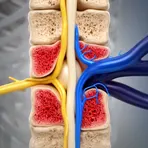
- Specialized
A blood vessel that drains blood from the spine through small holes next to spinal nerves
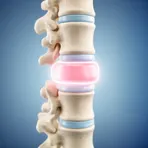

- Specialized
A tear in the soft part between the bones of the spine that presses on nerves and causes back pain
Surface Forms
Morphology
Etymology
Intervertebral comes from inter- meaning 'between' and vertebra meaning 'one of the small bones of the spine'. So intervertebral describes something that is 'between the vertebrae', for example the discs that sit between the back bones and cushion the spine.