
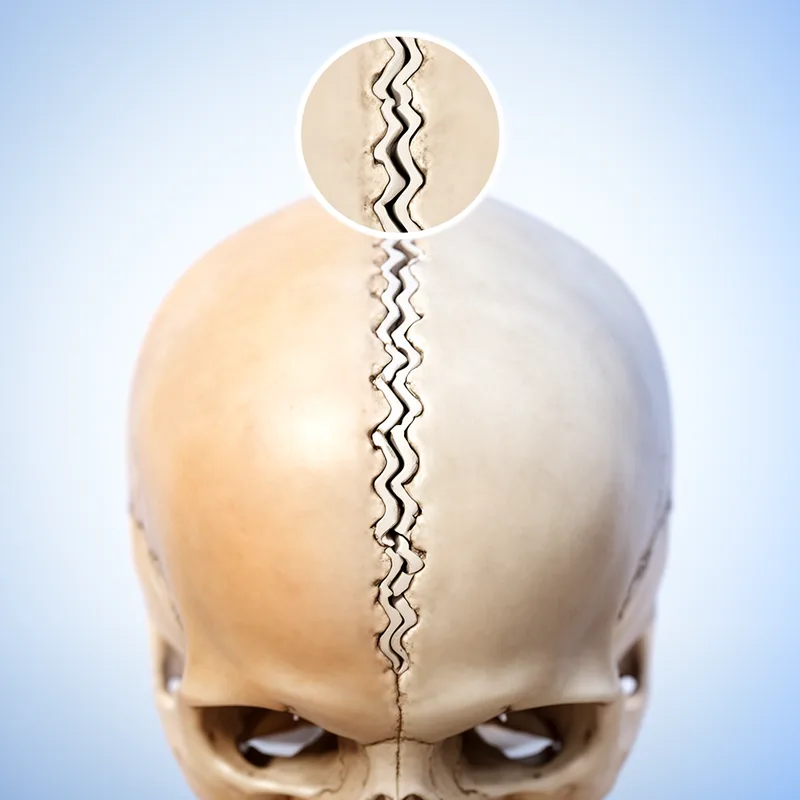
interparietal suture
- noun
- /ˌɪntərˈpærɪˌɛtəl ˈsuːtʃər/
- Specialized
- In rare cases, premature fusion of the interparietal suture can lead to skull deformities.
Examples
-
Cranial development studies often focus on the closure patterns of the interparietal suture.
-
During the autopsy, the coroner noted that the interparietal suture was intact.
-
The interparietal suture is a key feature of the human skull.
-
Can you identify the interparietal suture in this diagram?
-
During the autopsy, the coroner noted that the interparietal suture was intact.
-
In rare cases, premature fusion of the interparietal suture can lead to skull deformities.
-
The interparietal suture is important for connecting the two parietal bones in the skull.
Synonyms

A line down the middle where the two top bones of the skull meet

A line where the two bones at the top of the skull join
Surface Forms
Morphology
interparietal + suture
The term is compositionally built from interparietal (inter- meaning 'between' and parietal referring to the parietal bones) plus suture (an immovable fibrous joint), so the sense 'the joint connecting the two parietal bones of the skull' is directly derivable from the parts. Medical/Latin-derived anatomical formations follow regular morphological patterns, so a learner who knows the constituents can infer the meaning.
Etymology
Interparietal suture is made of three parts: inter- meaning 'between', parietal meaning the bones at the sides and top of the skull, and suture meaning a 'seam' like stitches. So the name paints a simple picture — a seam 'between the parietal bones' — which is why it means the joint that connects those skull bones.

