
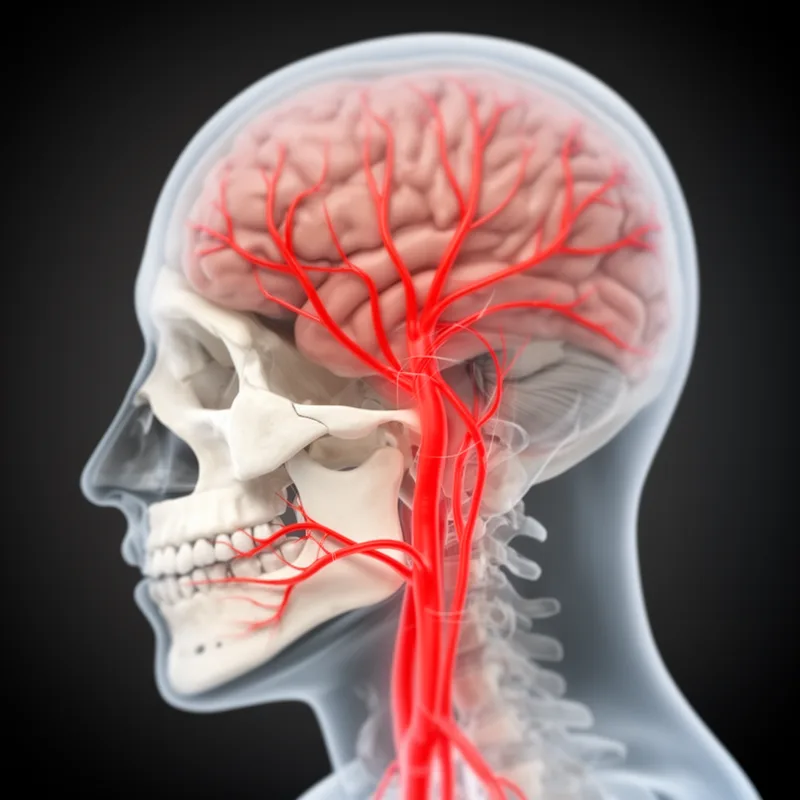
internal maxillary artery
- noun
- /ɪnˈtɜrnəl ˈmæksɪˌlɛri ˈɑrteri/
- Archaic
- After the trauma, the doctors monitored the patient's internal maxillary artery to assess any potential damage and prevent excessive bleeding.
- internal maxillary artery embolization
- distal internal maxillary artery
- left internal maxillary artery
Examples
-
Two cases of intractable epistaxis, which were definitively treated with internal maxillary artery embolization, are presented with an algorithm for the management of similar cases.
Academic text (1995) -
The left distal internal maxillary artery was then embolized with Gelfoam pledgets.
Academic text (2002) -
Patient 2: A: Left internal maxillary artery, pre-embolization; B: Post-embolization, showing complete occlusion.
Academic text (1995) -
Post-embolization angiography showed complete occlusion of the left internal maxillary artery and its distal branches.
Academic text (1995) -
Only one of our three patients (patient 3) experienced any significant vascular injury: a distal internal maxillary artery laceration that was detected and treated.
Academic text (2002) -
Two patients with intractable epistaxis who were definitively treated with internal maxillary artery embolization are presented, and the efficacy of this treatment is discussed.
Academic text (1995) -
Postembolization angiography revealed complete occlusion of both the left distal internal maxillary artery and the left facial artery (Figure 3, C).
Academic text (2002) -
The surgeon carefully evaluated the internal maxillary artery before proceeding with the operation to ensure proper blood supply to the face.
-
During the procedure, the team used imaging to locate the internal maxillary artery and avoid complications during the surgery.
Synonyms


 1
5.5
1
5.5
A blood vessel from the side of the neck that supplies blood to the face, jaw and mouth
A blood vessel that supplies the upper jaw, teeth, and face
Surface Forms
Morphology
The noun phrase is fully compositional: 'artery' (blood vessel) qualified by 'maxillary' (relating to the upper jaw) and 'internal' (located within), so a learner who knows the constituents can infer it is an artery located in or serving the internal maxillary region. Although it's a technical anatomical term with specific clinical details, the meaning follows standard anatomical naming patterns that are cross-linguistically common and therefore predictable.
Etymology
Internal maxillary artery is named from its parts: internal means 'inside', maxillary refers to the upper jaw (the maxilla), and artery means a blood vessel. So it is the blood vessel that runs inside near the upper jaw and gives blood to deep parts of the face and to the brain's coverings.