
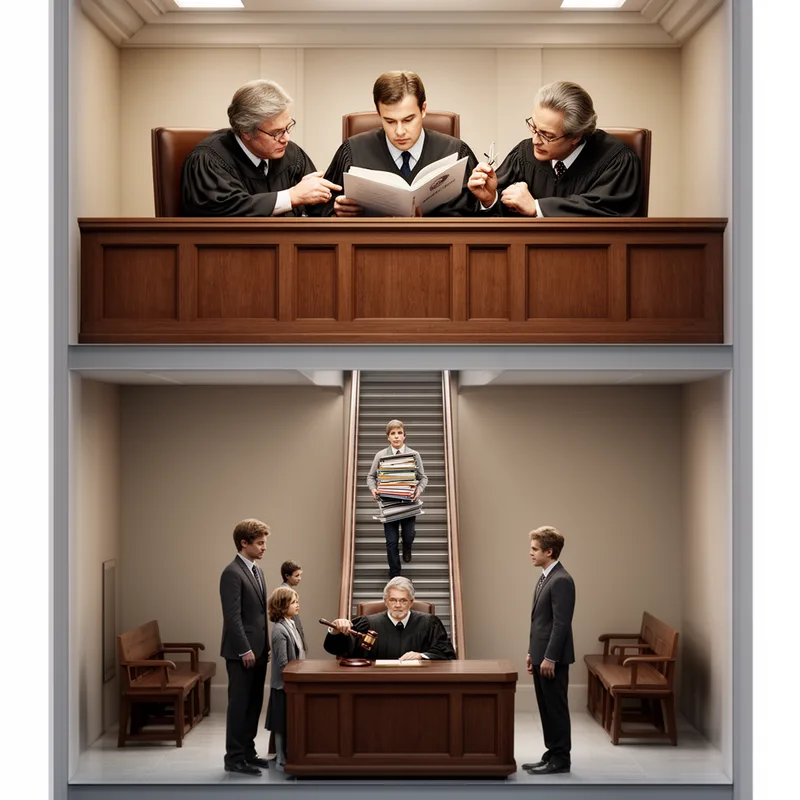
inferior court
- noun
- /ɪnˈfɪriər kɔrt/
- Specialized
- This evidence was enough to convict Adeline in the Elbert County inferior court.
- inferior and supreme courts
- justices of the inferior court
Examples
-
After 1811, three-judge panels made up of inferior court justices would preside over the capital trials of slaves.
Academic text (2009) -
Article III, Section 1 of the Constitution says that "the Judges, both of the supreme and inferior Courts, shall hold their Offices during good Behaviour."
Academic text (2006) -
Precedent is the decision rule that once a legal holding is established by an appropriate court, that legal conclusion will be followed by the same court and by all inferior courts in similar or identical cases in the future.
Academic text (1997) -
Article III, Section 1 of the Constitution provides that "the Judges, both of the supreme and inferior Courts, shall hold their Offices during good Behaviour." (n328)
Academic text (2006) -
In 1849, Georgia governor George Towns delivered an address to the state legislature in which he argued that justices of the inferior court were not competent to render judgment in slave capital cases.
Academic text (2009) -
The appeal was sent to the higher court after the decision of the inferior court was contested.
-
He was dissatisfied with the ruling and decided to take his case to a higher court, challenging the inferior court's verdict.
-
In many legal systems, the decisions made by an inferior court can be reviewed by a supreme or appellate court.
Synonyms

 27
3.6
27
3.6

A court whose decisions can be reviewed by a higher court
Surface Forms
Morphology
The meaning is directly and compositionally derived from 'inferior' (lower in rank) modifying 'court' (a judicial forum), so it denotes a lower or subordinate court whose decisions can be reviewed by a higher court. This adjective+noun pattern is straightforward and cross-linguistically common, so a B1 learner who knows both words will readily grasp the MWE's meaning.
Etymology
Inferior court comes from the simple image of a court that is 'lower' in rank, with inferior meaning 'lower'. One popular idea is that decisions from this lower court could be sent up to a higher court to be 'reviewed' or 'changed', so the phrase means a court whose decisions may be reviewed by a higher court.