
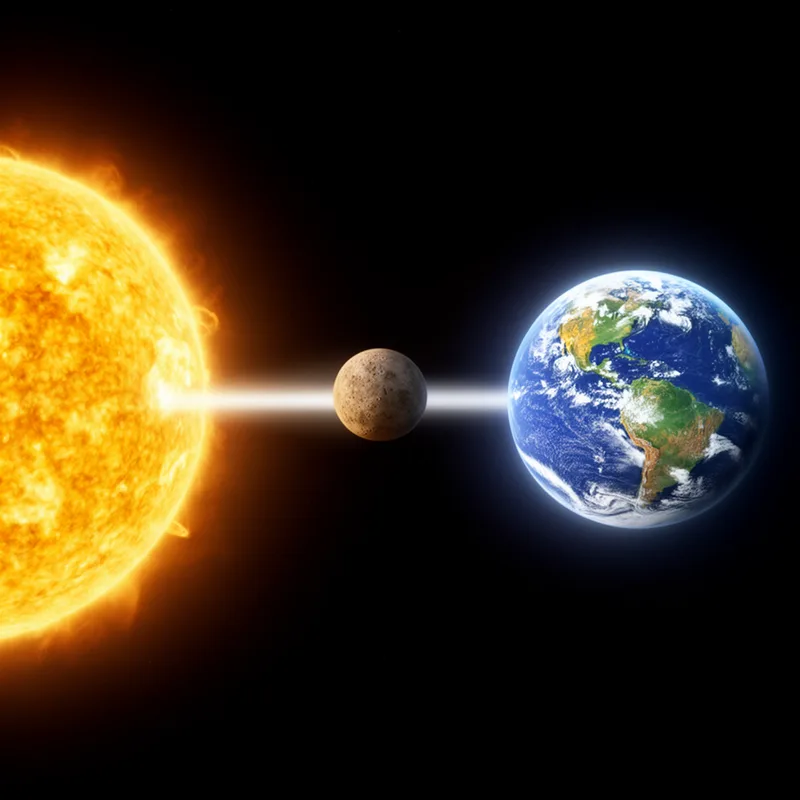
inferior conjunction
- noun
- /ɪnˈfɪəriər kənˈdʒʌŋkʃən/
- Specialized
- Today, Venus is at inferior conjunction, appearing directly between the Earth and the Sun.
- Mercury is in inferior conjunction
- Venus reaches inferior conjunction
- inferior conjunction with Earth
Examples
-
Mercury will achieve inferior conjunction tomorrow, aligning perfectly with the Earth and the Sun.
-
Remembering that the Sun subtends an angle of only about one degree in the sky, it is easy to see why there is not a transit of Venus every time it is at inferior conjunction: Venus is usually either too low or too high to be seen against the Sun.
Academic text (2004) -
It is only when Venus is at inferior conjunction with Earth (between our planet and the Sun) and Earth is near one of these two points that a Venus transit can occur.
Academic text (2004) -
During inferior conjunction, the planet is positioned on the same side of the Sun as Earth, creating a straight line.
Surface Forms
Morphology
The term is compositionally built from 'inferior' (a planet whose orbit lies closer to the Sun than Earth's) and 'conjunction' (an alignment/close apparent pairing of bodies). Given those constituent meanings, a learner can predict it denotes a conjunction involving an inner (closer) planet, so despite being technical the meaning is directly derivable from the parts.
Etymology
Inferior conjunction uses inferior to mean 'closer to the Sun', not 'worse', and conjunction to mean 'coming together'. So it names the moment when a planet that orbits inside Earth's path comes directly between Earth and the Sun and they appear in a straight line.

