
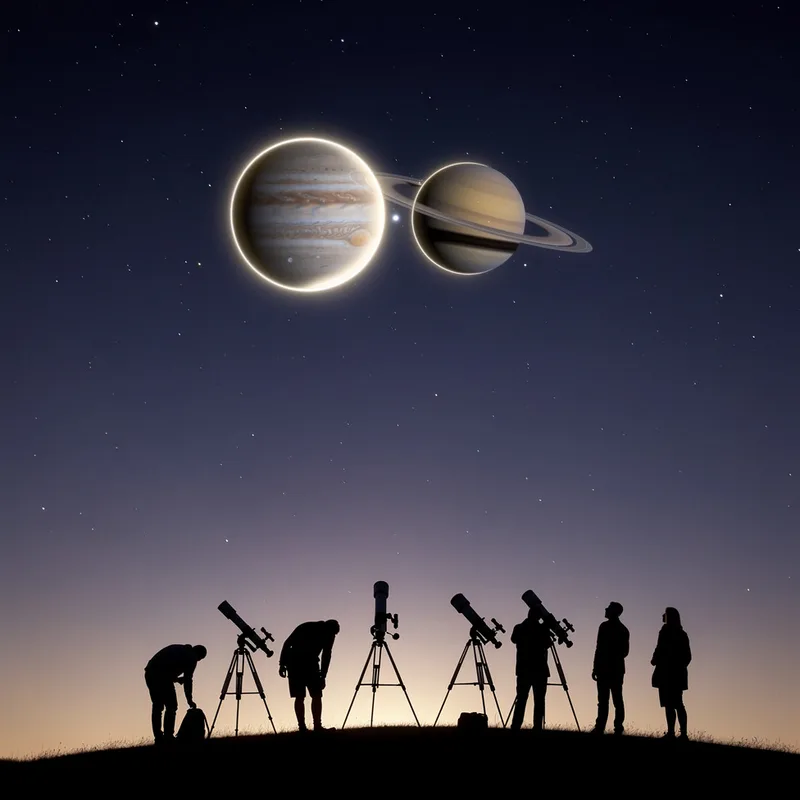
conjunction
 4
8.6
4
8.6

- noun
- /kənˈdʒʌŋkʃən/
- Specialized
- After the conjunction, Jupiter continues to climb higher while Venus dips lower.
- conjunction in the sky
- conjunction with the Sun
- conjunction of Jupiter
Examples
-
Mars also climbs higher in the weeks after the planetary conjunction.
Academic text (2006) -
Three bright planets gather in the evening twilight for one of the best planetary conjunctions of 2005.
Academic text (2005) -
Now, ask what the Great Conjunction is.
-
The Great Conjunction is at hand.
-
A thousand years ago, there was a Great Conjunction.
-
Hanging in the sky are the moon and a planet in conjunction, all signalling an important event.
-
Mars is in direct conjunction with Saturn.
-
A spectacular conjunction of the two brightest planets will turn heads in early September.
Academic text (2005) -
On saturday night, we'll be able to see comet forsey in conjunction with the moon for the first time in 300 years.
-
Mars is currently in conjunction with Venus, creating a beautiful sight in the night sky.
Synonyms
 20
6.8
20
6.8
When planets, the Sun and the Moon appear near each other in the sky
Antonyms

Compounds

- Specialized
A word that joins two words, phrases, and short sentences, for example and, but, or

- Specialized
A word that joins parts of a sentence, like 'and', to show addition


- Specialized
A planet that lies directly between Earth and the Sun in a straight line

- Specialized
When a planet is on the far side of the Sun from Earth so we cannot see it

- Specialized
A word that introduces a clause that cannot stand alone, like because or although

- Specialized
A word that joins a part of a sentence to the main sentence, like because or although
Surface Forms
Morphology
conjunction = conjunct (semi-transparent) = con + junct + ion
The astronomical sense ('apparent meeting/passing together') is a specialized extension of 'joining' and may not be fully transparent to learners without domain knowledge.
Etymology
Conjunction comes from the Latin parts con- 'together' and jungere 'to join', like the English word join. In astronomy it means two or more planets or stars appear 'joined' or very close together in the sky.