
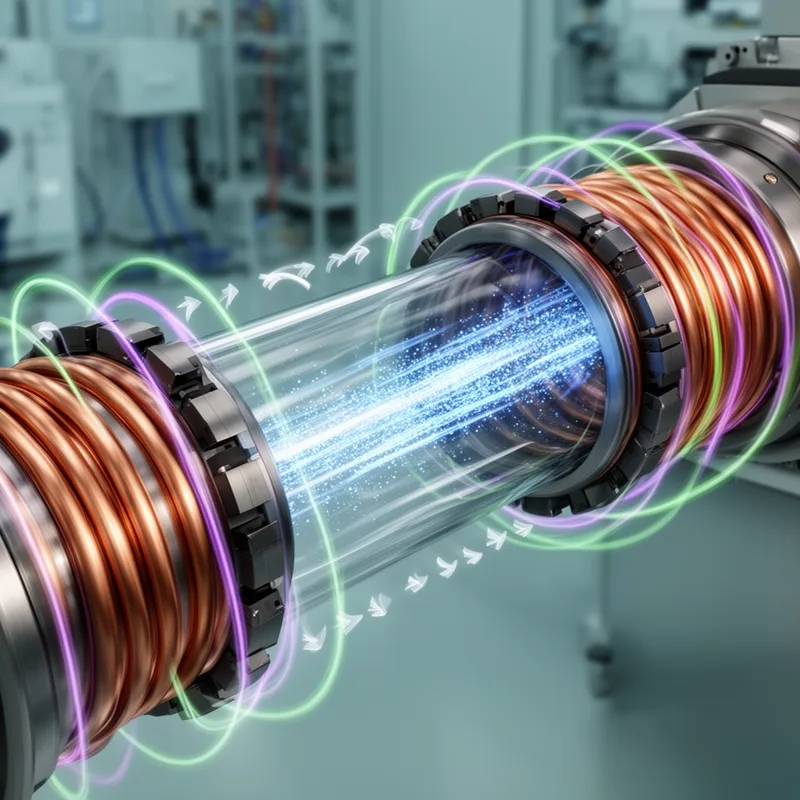
induction accelerator
- noun
- /ɪnˈdʌkʃən əkˈsɛləˌreɪtər/
- Specialized
- An induction accelerator boosts the energy of a continuous beam of electrons by using changing magnetic fields.
Examples
-
The induction accelerator was essential for achieving the high electron energies needed in the experiment.
-
By employing an induction accelerator, scientists can generate intense X-ray pulses for imaging.
-
Researchers use an induction accelerator to study the properties of plasma under extreme conditions.
-
The induction accelerator is crucial for modern physics experiments.
-
Many researchers utilize an induction accelerator for their studies.
-
Using an induction accelerator, physicists can significantly enhance the speed of electrons in their experiments.
-
In advanced laboratories, an induction accelerator is employed to produce high-energy particles for various research applications.
Synonyms

 48
7.1
48
7.1

A machine that makes particles move faster for scientific study
 11
5.5
11
5.5
A machine that makes tiny charged particles move faster for science or medicine
 2
6.8
2
6.8
A machine that makes tiny particles inside atoms move very fast for experiments or medical treatment
Surface Forms
Morphology
The compound straightforwardly combines 'induction' (the process involving changing magnetic fields) with 'accelerator' (a device that increases particle speed), so the meaning 'an accelerator that uses induction' is directly derivable from the parts. Although the concept is technical, the compositional logic is transparent and predictable for a learner who knows both constituent meanings.
Etymology
The noun induction accelerator comes from the words induction and accelerator. In this machine a changing magnetic field makes an electric 'push' that speeds up a steady stream of electrons, so the name means a device that increases the speed of that stream.