
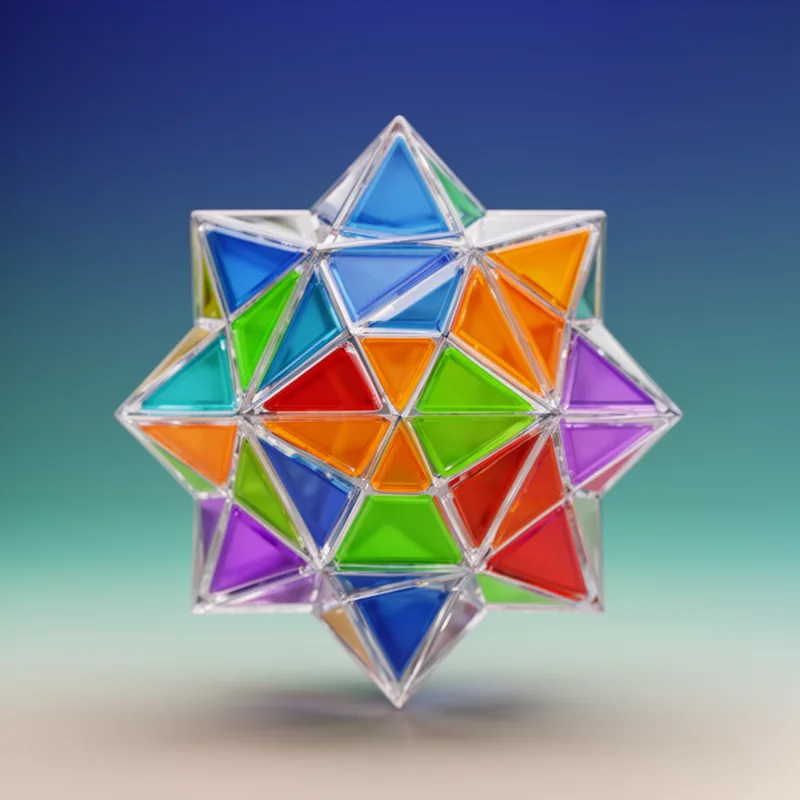
icosahedron
 1
9.9
1
9.9

- noun
- /ˌaɪkəˈsiːhɪdrən/
- Specialized
- He constructed an icosahedron out of paper, making sure each face was perfectly flat.
- truncated icosahedron
- regular icosahedron
Loading YouTube…
Watch on YouTubeIt's a truncated icosahedron, very important.
- It's a truncated icosahedron, very important.
- So there's octahedron, extrahedron through tetrahedrons, dolcahedron, icosahedron.
Examples
-
In geometry class, we learned that an icosahedron has twenty triangular faces.
-
It's a truncated icosahedron, very important.
-
Nothing else fits the bill as well as a truncated regular icosahedron.
Academic text (1996) -
The truncated icosahedron (TICO) is the shape most widely used for a soccer ball.
Blog text (8) -
The icosahedron (ICO) is one of the five Platonic solids.
Blog text (8) -
All the 60 vertices of a truncated regular icosahedron are identical; each one is the junction of two hexagons and a pentagon.
Academic text (1996) -
With 20 triangular sides, the icosahedron has twofold, threefold, and fivefold symmetry and the largest volume-to-surface ratio of the Platonic solids.
Academic text (2004) -
An icosahedron is a solid geometric figure with twenty plane faces.
Synonyms
A solid with twenty triangles that all have equal sides
Compounds
How Many Faces
- Specialized
1
9.9

- Specialized
1
9.6
- Specialized
- Specialized
1
8.2
130
1.0
- Specialized
2
7.6
Surface Forms
Morphology
icosahedron = icosa + hedron
The elements 'icosa-' and '-hedron' are specialized Greek combining forms not recognizable as standalone English words to an average B1 learner, so the meaning is not reliably derivable from known base words.
Etymology
The word icosahedron comes from Greek parts eikosi ('twenty') and hedra ('seat' or 'face'). Think of it as 'twenty faces', like a twenty-sided die, which is why an icosahedron is a solid with twenty flat faces.