

ice cap
 19
3.4
19
3.4

- noun
- /aɪs kæp/
- I'm amazed at how much the polar ice caps are changing.
- polar ice caps
- ice caps melt
- Greenland ice cap
Loading YouTube…
Watch on YouTubeSo it's not just the ice caps, the permafrost in the north as well.
- So it's not just the ice caps, the permafrost in the north as well.
- And irreversible, no matter what we do, is ongoing ocean acidification, ice cap melting, rising seas.
- Well, I'm not sure about that because we don't know that much about the effects of detonating hydrogen warheads to melt the polar ice caps.
- There's a mountains of Admiral burst that there were mountains of coal with no ice caps.
Examples
-
Why are Greenland and the polar ice caps melting?
Academic text (2009) -
And 90% of the ice cap is under the surface, bathing in that water.
Blog text (21) -
The north polar ice cap looks entirely different.
-
The ice caps are melting.
-
"Nothing could have been done, anyway; the submarine was below the polar ice cap at the time."
Fiction book (2001) -
Because the polar ice caps are melting all the time.
-
Long before man and the industrial revolution, the ice cap was receding, or in other words, melting.
Blog text (23) -
The polar ice caps have melted, covering the earth with water.
-
The stories concerning the polar ice caps melting at a fast rate are true and not propaganda.
Blog text (13) -
The Arctic ice cap is a crucial part of the planet's climate system.
Synonyms
 5
3.9
5
3.9
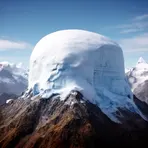
A large, thick area of ice and snow that covers land, especially at the poles and on high mountains

A dome of ice that covers part of a polar region or high mountain
How Big


Surface Forms
Morphology
The compound is transparently built from 'ice' (frozen water) + 'cap' (a cover or top), so its meaning—an ice covering on the top of a landmass—is directly inferable. This noun–noun composition and the idea of a ‘‘cap’’ as a covering is cross‑linguistically common, so a B1 learner who knows both words would readily understand it.
Etymology
The noun ice cap comes from the picture of a cap (a hat) of ice sitting on the land like a hat on a head. That's why it means 'a thick layer of ice' that covers the top of high mountains or the poles.