
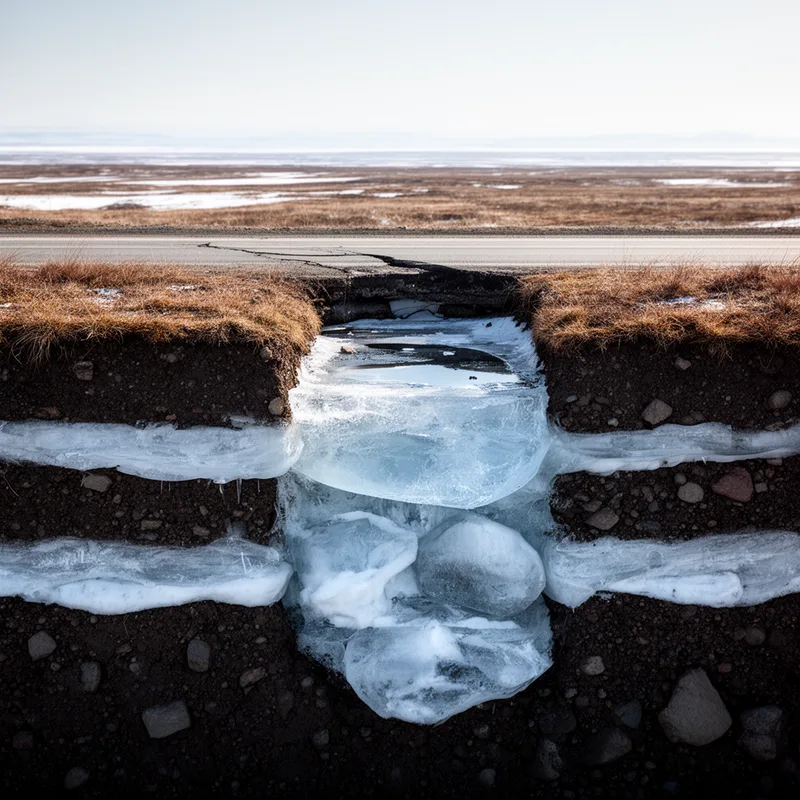
ground ice


 1
7.2
1
7.2
- noun
- Specialized
- Thawing ground ice can cause the land above to sink and create uneven terrain.
Examples
-
In Alaska, ground ice can cause significant landscape changes.
-
Thawing ground ice can lead to the formation of small ponds on the surface in spring.
-
Much of the visible damage to northern roads is a result of melting ground ice.
-
Scientists drilled into the tundra to study the ground ice beneath the surface.
-
The ground ice was thick this winter.
-
Scientists drilled into the permafrost to collect samples of ground ice for analysis.
-
In regions with permafrost, ground ice plays a crucial role in the ecosystem and hydrology.
Synonyms
Thin layers or pockets of ice inside frozen ground that form when water moves into the soil and freezes
How Much

Surface Forms
Morphology
The meaning is directly compositional: it denotes ice associated with or located in the ground, which a learner who knows 'ground' (earth/soil) and 'ice' (frozen water) can infer. Although the term is technical in geology, the noun+noun compounding pattern is literal and cross-linguistically common, so the sense is readily understandable to a B1 learner.
Etymology
Ground ice is a literal name: it is ice that forms under the ground when water in the soil freezes in very cold places. That's why 'ground ice' means the ice inside soil that can melt and make the land sink or become uneven.