
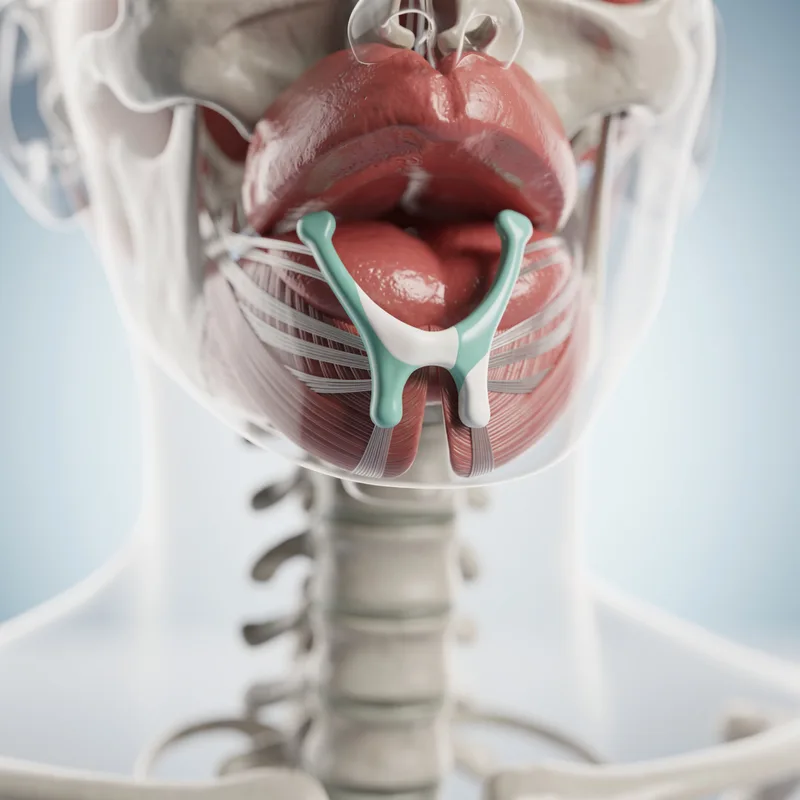
hyoid bone
 5
8.1
5
8.1

- noun
- /ˈhaɪɔɪd boʊn/
- Specialized
- During the examination, the surgeon identified the hyoid bone as intact.
- level of the hyoid bone
- coordinates of the hyoid bone
- portion of the hyoid bone
Examples
-
The doctor explained that the hyoid bone supports the muscles of the tongue.
-
Surgical exploration revealed that an encapsulated, fibrofatty nodular mass extended from the hyoid bone down to the supraclavicular fossa.
Academic text (2005) -
Was the hyoid bone broken?
-
The first is to remove a central portion of the hyoid bone.
Academic text (2006) -
The hyoid bone was intact, so death was not due to strangulation. -
-
Patients typically present with a painless midline swelling below the hyoid bone.
Academic text (2006) -
The thyroglossal duct extended from the cyst to the hyoid bone.
Academic text (2006) -
On digital examination, the otolaryngologist was able to palpate through the necrotic areas down to the hyoid bone.
Academic text (2004) -
Neck exploration revealed purulent drainage originating from the lateral border of the hyoid bone.
Academic text (1995) -
Examination revealed that the mass was a mobile, firm, nontender, 4-cm nodule at the level of the hyoid bone, anterior to the sternocleidomastoid muscle.
Academic text (2006)
Synonyms
 8
9.9
8
9.9
A small U-shaped bone under the tongue that supports tongue muscles and is not attached to other bones

A U-shaped bone under the tongue that supports its muscles
Surface Forms
Morphology
The phrase is fully compositional: 'hyoid' identifies a specific anatomical item and 'bone' marks it as a bone, so the combined phrase denotes that particular bone. If a B1 learner knows both constituent meanings, the overall meaning (a U-shaped bone in the neck supporting the tongue muscles) is directly derivable and follows a standard noun+noun specification pattern.
Etymology
The noun hyoid bone comes from an old Greek word. The part hyoid meant 'U-shaped'. The small bone under the tongue really looks like a U, so the name shows its shape and why it supports the tongue.