

hummingbird moth
- noun
- /ˈhʌmɪŋbɜrd mɔθ/
- We spotted a hummingbird moth at dusk, feeding among the blossoms in the backyard.
Examples
-
Gardeners often mistake the hummingbird moth for a tiny bird because of its rapid wing movements.
-
The hummingbird moth hovered over the flowers, sipping nectar with its long proboscis.
-
Look at that hummingbird moth!
-
Wow, a hummingbird moth!
-
The hummingbird moth hovered gracefully over the blooming flowers, feeding on their nectar.
-
While gardening, I spotted a hummingbird moth flitting from blossom to blossom, mimicking the movement of a real hummingbird.
-
Many people are surprised to learn that the hummingbird moth is actually a moth, not a bird.
Synonyms


 1
6.5
1
6.5
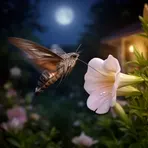
A large night insect with long wings that hovers to drink flower nectar
 1
8.1
1
8.1
A large moth with long wings that hovers to drink flower nectar
 1
9.9
1
9.9
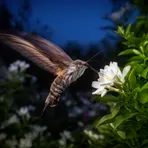
A large moth with long narrow wings that hovers to feed from flowers
 1
8.4
1
8.4
A large moth that hovers like a hummingbird to feed from flowers
Surface Forms
Morphology
The compound combines 'hummingbird' (a small bird known for hovering) with 'moth' (an insect), so a learner who knows both words can infer it denotes a moth that resembles or behaves like a hummingbird (e.g., hovers while feeding). This noun+noun compositional pattern is productive and cross-linguistically common, making the meaning directly derivable for a B1 learner.
Etymology
Hummingbird moth was named because this moth looks and moves like a small hummingbird: it hovers by flowers and drinks nectar with a long straw-like tongue. So, the name helps you remember that it is a 'moth' that acts like a 'hummingbird'.