
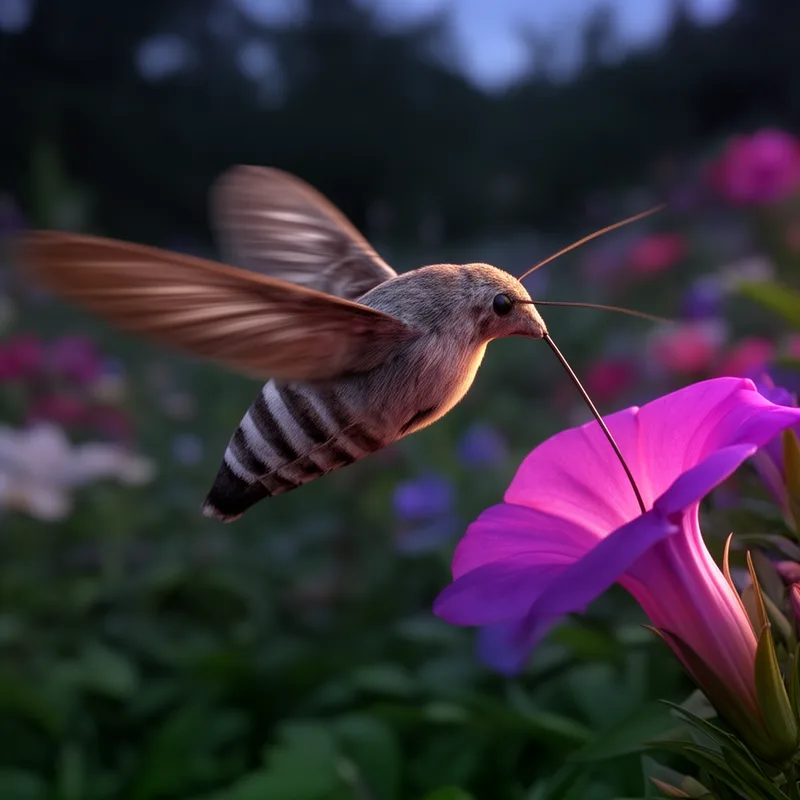
sphinx moth


 1
8.4
1
8.4
- noun
- /sfɪŋks mɔθ/
- US
Examples
-
Creek and other Muskogean Indians lean toward moth because they see the symbol as representing the sphinx moth that pollinates the tobacco used in ceremonies.
Academic text (2002) -
A sphinx moth hovered gracefully as it drank nectar from the vibrant flowers.
-
During the summer, we often see sphinx moths flitting between the blossoms in our garden.
-
The sphinx moth is known for its remarkable ability to hover in mid-air while feeding.
Synonyms
 71
1.0
71
1.0
An insect like a butterfly that flies at night, often with feathery antennae
 1
8.1
1
8.1
A large moth with long wings that hovers to drink flower nectar
 1
6.5
1
6.5
A large night insect with long wings that hovers to drink flower nectar
 1
9.9
1
9.9
A large moth with long narrow wings that hovers to feed from flowers

A moth that hovers like a hummingbird while it drinks nectar from flowers
Surface Forms
Morphology
sphinx + moth
The compound is a noun-noun construction where 'moth' supplies the category and 'sphinx' specifies the type or name, so a learner who knows both words can infer it denotes a kind of moth associated with or named after a sphinx. Although detailed biological traits (e.g. hovering, long narrow forewings) are not fully derivable, the basic meaning as a specific kind of moth is transparently predictable from the constituents.
Etymology
Sphinx moth gets its name from the caterpillar, which often lifts its head and front body into a stiff, curved pose like the stone sphinx when it feels threatened. That's why the name fits these large moths, which are also known for strong flight and the ability 'to hover' at flowers.