
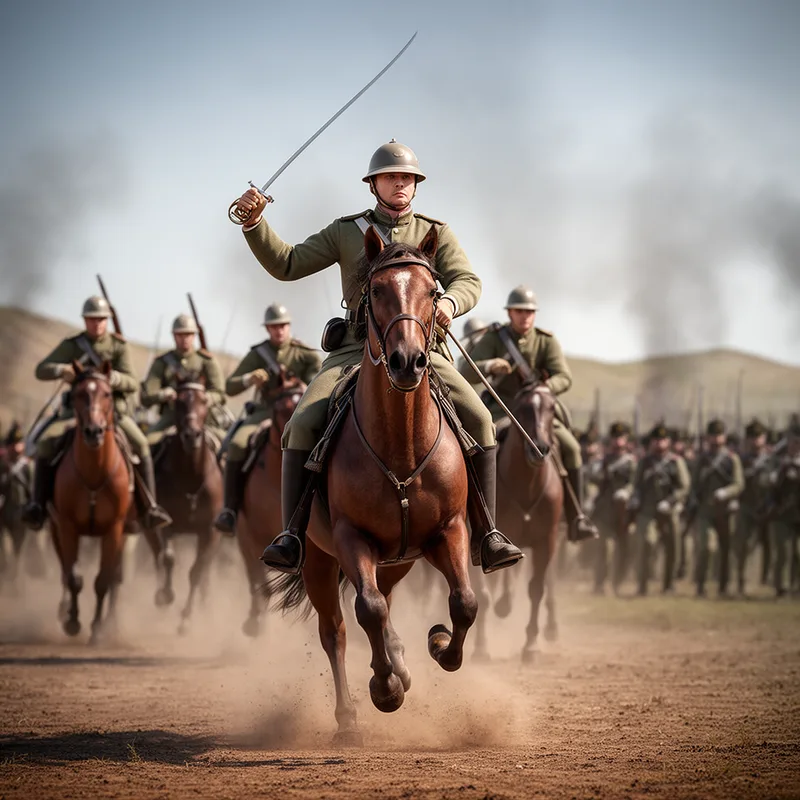
horse cavalry


 1
7.2
1
7.2
- noun
- /hɔrs ˈkævəlri/
- In historical warfare, horse cavalry units often played a decisive role in charging enemy positions.
- horse cavalry and infantry
- horse cavalry in the attack
- light infantry and horse cavalry
Examples
-
I think there are some developments in military force that make horse cavalry permanently obsolete as a standard-issue offensive tool.
Blog text (20) -
Obama gets in the last word on this exchange and gets to make a mockery of Romney's plans by arguing them to absurdity, suggesting that having a smaller navy is the same thing as having less horse cavalry.
Blog text (22) -
Well, certainly, a horse cavalry is a thing of the past but that's not the point.
-
It is shown that Spanish infantry tactics and horse cavalry were critical factors in the Spanish victory.
Academic text (1992) -
It originated with horse cavalry when the sword was still the cavalryman's primary weapon.
Blog text (22) -
An army with such technology has an overwhelming advantage over an army without it, much as an army equipped with tanks would overwhelm an army with horse cavalry.
Academic text (1991) -
"We witnessed the horse cavalry bounding "from spur to spur to attack Taliban strongpoints.
-
During the battle, the horse cavalry charged forward, providing crucial support to the infantry.
-
The museum displayed artifacts from the era when horse cavalry were the primary cavalry force in military campaigns.
Synonyms
 150
6.0
150
6.0
Soldiers who fight on horses or in armored vehicles
 18
5.8
18
5.8
A soldier who fights in tanks or armored vehicles
 11
6.6
11
6.6
A military unit of soldiers on horses with two or more troops and a headquarters
 10
4.2
10
4.2
A person who rides horses very well
 8
9.9
8
9.9
A soldier who rides a horse and fights on foot
 2
8.1
2
8.1
A soldier who fights on horseback or in vehicles
 1
7.9
1
7.9
A soldier or knight who fights while riding a horse
 1
9.9
1
9.9
A soldier who rides fast horses and wears fancy uniforms
 1
3.1
1
3.1
A person on a horse, often for sport or travel
 1
9.9
1
9.9
Volunteer soldiers on horses in Britain formed to defend the country

A soldier who fights on horseback

A soldier on horseback who fights using a long pole with a metal tip

A woman soldier who fights while riding horses or in armored vehicles
Surface Forms
Morphology
The meaning is directly and transparently derived from combining 'horse' (a riding animal) with 'cavalry' (soldiers who fight on horseback); a B1 learner who knows both words can infer 'soldiers who fight while riding horses'. The phrase is compositional and cross-linguistically obvious, though slightly redundant since 'cavalry' already often implies horses.
Etymology
Horse cavalry comes from the simple image of soldiers on horses charging into battle to move fast and break enemy lines. That's why it means 'soldiers or military units that fight while riding horses'.