

homologous
 2
7.7
2
7.7

- adjective
- /həˈmɒl.ə.ɡəs/
- Specialized
- Immunosuppression associated with homologous blood transfusion was first observed in renal allograft transplantation.
- homologous blood
- homologous blood transfusion
- homologous group
Loading YouTube…
Watch on YouTubeAll of the structures where Ned and ADH bind are are homologous to each other.
- All of the structures where Ned and ADH bind are are homologous to each other.
- So the clitoris is, you know, the structure on the top of the vulva, which is homologous to the male penis.
- So this is called homologous based repair.
- Well, actually it was taken from the two homologous chromosomes for my parents because they underwent myosis in order to create a zygote, which was me.
Examples
-
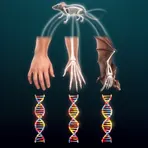
If we look across the ancestors, we can see the homologous organs.
-
Clinical and experimental studies have left little doubt that homologous blood transfusions are immunosuppressive in human beings.
Academic text (1994) -
If more blood was needed, homologous blood was used.
Academic text (1994) -
The strongest association for all the variables observed was the transfusion of homologous blood.
Academic text (1994) -
Genetic testing revealed homologous sequencing in specimens from 20 humans and 8 mice.
Academic text (2012) -
So the clitoris is, you know, the structure on the top of the vulva, which is homologous to the male penis.
-
All of the structures where Ned and ADH bind are are homologous to each other.
-
Of the 120 participants, 58 were assigned autologous and 62 homologous blood transfusions.
Academic text (1994) -
The transfusion of homologous fresh-frozen plasma was not related to the risk of infection (p=0.129).
Academic text (1994) -
The forelimbs of humans and bats are homologous, sharing a similar bone structure despite their different functions.
Synonyms


 1
9.9
1
9.9
Coming from the same ancestor even if they have different functions
 1
9.9
1
9.9
Genes or body parts in different species that come from a common ancestor

Body parts that come from the same ancestor, even if they do different things
Antonyms

- Specialized
1
7.0
Having the same job in different living things but coming from different ancestors

How Homologous

Surface Forms
Morphology
homologous = homology (semi-transparent) = homo + log + ous
The adjectival relation to 'homology' is predictable ('-ous' forming an adjective), but the combining form 'homo-' and 'log' are technical/Greek-derived elements that may be unfamiliar to general learners.
Etymology
Homologous comes from Greek parts homo- meaning 'same' and -logos meaning 'relation' or 'reason', the same homo- you see in homophone or homogeneous. So in biology homologous describes things (like a bat wing and a human arm) that have the 'same' origin or structure even if they do different jobs.