
orthologous


 1
9.9
1
9.9
- adjective
- /ˌɔrˈθɑl.ə.gəs/
- Specialized
- Orthologous sequences were defined and grouped in orthogroups across the nine species by OrthoFinder with default settings (Emms and Kelly 2015).
- orthologous genes
- orthologous to mammalian
- orthologous and paralogous
Examples
-
Research indicates that orthologous genes between different plant species can help us understand evolutionary relationships.
-
The greatest number of conserved AS events are found in orthologous genes between grasses (Figure 2).
Academic text (2017) -
Each event is present in two or more orthologous genes, and thus distributes across 19,235 genes (Table 1; Materials and Methods).
Academic text (2017) -
Conserved AS events identified by this process were clustered, and each cluster may contain conserved AS events identified between orthologous genes across species (1:1) as well as between paralogs.
Academic text (2017) -
This family of proteins is orthologous to large repetitive RTX domain-containing proteins found in Pseudomonas putida, which mediate biofilm development 55.
Academic text (2018) -
Paralogous genes are not homologues, so inferences from analyses containing a mixture of orthologous and paralogous copies will yield spurious taxon relationships.
Academic text (2010) -
We have thus been able to use a draft genome assembly to identify a locus by mapping by sequencing. The O. tipulae cov-3 locus is orthologous to C. elegans mig-13.
Academic text (2017) -
Scientists discovered that the gene orthologous in humans is orthologous to the gene DEF1 in mice, revealing their shared ancestry.
-
To study evolution, researchers compare orthologous genes from various species to trace their genetic similarities.
Synonyms
 2
7.7
2
7.7
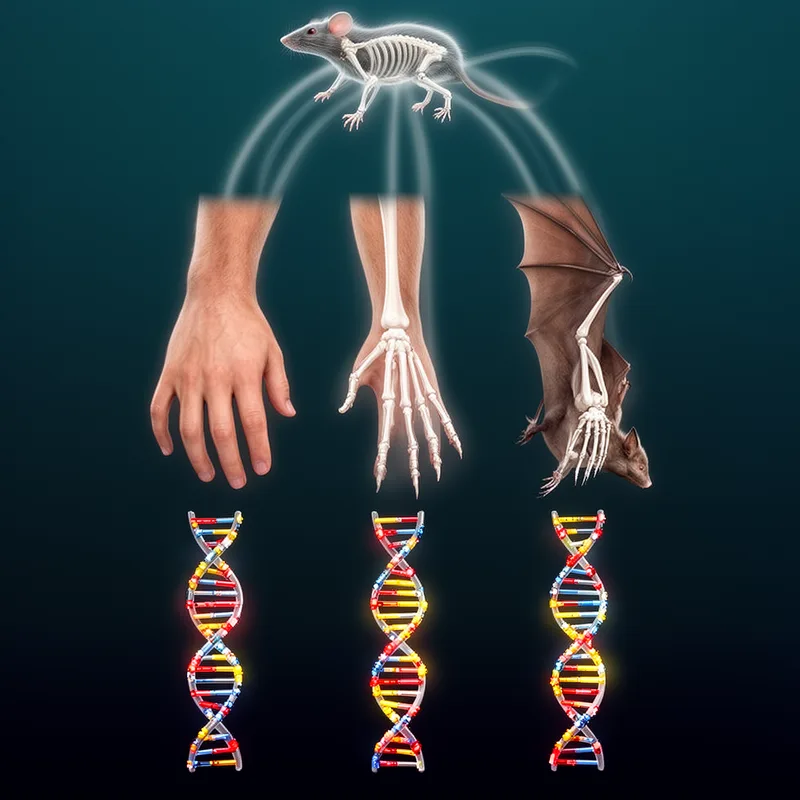
Having the same basic structure and origin, often in body parts like arms and wings
 1
9.9
1
9.9
Coming from the same ancestor even if they have different functions

Body parts that come from the same ancestor, even if they do different things
Surface Forms
Morphology
Etymology
Orthologous comes from Greek parts ortho- meaning 'straight' or 'correct' and -logous from logos meaning 'relation' or 'study', and you can see ortho- in orthodox and the same root in logic. So, orthologous describes genes or parts in different species that are 'correctly related' because they come from the same ancestor.