

holophyte
- noun
- /ˈhoʊləˌfaɪt/
- Specialized
- Many algae are classified as holophytes because they make their own food through photosynthesis.
Examples
-
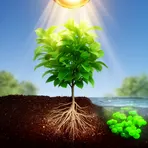
A holophyte absorbs sunlight and uses it to convert carbon dioxide and water into energy.
-
Many plants, like wheat and corn, are considered holophytes because they produce their own food.
-
The distinction between holophyte and heterotroph is fundamental in biology.
-
A holophyte can thrive in sunlight.
-
Many holophytes are essential for the ecosystem.
-
A holophyte uses sunlight to create food through the process of photosynthesis.
-
In a simple ecosystem, a holophyte plays a crucial role by generating energy for other organisms.
Synonyms

 2
9.3
2
9.3

A living thing that makes its own food from sunlight or chemicals

 1
7.4
1
7.4
A living thing that makes its own food from sunlight or chemicals, like plants

A plant that makes its own food using sunlight and air

A plant that makes its own food from sunlight, water, and air
Antonyms

- Specialized
1
9.4
A living thing that gets food by eating other living things or dead matter
Surface Forms
Morphology
holophyte = holo + phyte
Both elements are Greek scientific combining forms (holo- and -phyte) that are not standalone English words and so will not help a typical B1 learner infer the meaning.
Etymology
The word holophyte comes from the Greek parts holo- meaning 'whole' and -phyte meaning 'plant'. So a holophyte is a plant or other living thing that 'makes its own food' from sunlight rather than eating other living things.