

holly-leaves barberry
- noun
- US
- The holly-leaves barberry is often planted in gardens for its decorative foliage and bright berries.
Examples
-
I bought a holly-leaves barberry to add some color to my backyard.
-
Birds are attracted to the blue-black berries of the holly-leaves barberry in autumn.
-
The holly-leaves barberry adds color to the garden.
-
I planted several holly-leaves barberries last spring.
-
The holly-leaves barberry is a popular choice for landscape design due to its attractive foliage.
-
In my garden, the holly-leaves barberry blooms with bright yellow flowers during the spring.
-
Many homeowners appreciate the holly-leaves barberry for its ability to thrive in various soil types.
Synonyms

An evergreen shrub with dark green leaves with several parts, yellow flower clusters, and dark blue berries

An evergreen garden shrub that has shiny divided leaves, yellow flowers, and dark blue berries
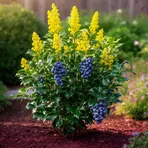
An evergreen shrub with dark green divided leaves, yellow flower clusters, and blue-black berries often grown in gardens

A low bush with dark green leaves that stay all year and blue-black berries

A small evergreen bush with spiny leaves, yellow flowers, and blue-black berries
Surface Forms
Morphology
holly-leaves + barberry
The compound is a descriptive noun phrase: a 'barberry' characterized by 'holly-like leaves', so a learner who knows 'holly', 'leaves' and 'barberry' can infer it denotes a barberry shrub with leaves like a holly. This follows regular English compounding (modifier + noun) and is cross-linguistically transparent, so the meaning is directly derivable from the constituents.
Etymology
Holly-leaves barberry comes from the plant's look: it is a kind of barberry with dark, pointed leaves like a holly and that has blue-black berries. That's why the name means 'a small evergreen bush with holly-like leaves and dark berries'.

