

hip joint
 2
3.5
2
3.5

- noun
- /hɪp dʒɔɪnt/
- Specialized
- OK, so you have additional degrees of freedom in the hip joints to allow it to to move little bit more like a human.
- hip joint replacement
- total hip joint
- hip joint surgery
Examples
-
Purpose: To investigate patient expectations of and satisfaction with in-hospital discharge planning after total hip-joint replacement surgery in early and late discharge patient groups.
Academic text (2003) -
Many patients can reasonably expect artificial hip joints to last 20 to 25 years.
-
Many patients can reasonably expect artificial hip joints to last 20 to 25 years.
Academic text (2004) -
The company has decided not to develop metal-on-metal hip joints.
Academic text (2004) -
The femoral head of a degenerative hip joint removed during surgery is pictured at the bottom.
Academic text (2004) -
Surface replacement was designed to replace only the diseased surfaces of the hip joint, while preserving the normal anatomy and biomechanical function of the joint and proximal femur.
Academic text (1991) -
The standardized sit-and-reach test was used to measure lower back and hip joint flexibility. The number of bent-leg curl-ups attained in 1 minute was used to test abdominal muscles.
Academic text (2013) -
Extra weight means more pressure on the hip joint at every step and, therefore, more pain.
-
Leading with your foot opens up your hip joint and takes pressure off your spine.
Synonyms


 1
4.1
1
4.1
A joint where a round bone end fits into a cup, allowing movement in many directions
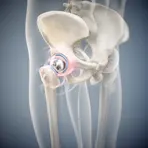
A ball-and-socket joint between the thigh bone and the hip bone that lets the leg move

The ball-and-socket joint where the thigh bone meets the hip bone

A joint where a rounded bone end fits into a cup in another bone, like the hip or shoulder

A joint where a round bone end fits in a cup, letting movement in all directions
How Mobile
- Specialized
1
3.9

- Specialized
2
3.5
1
3.0
2
2.3
- Specialized
1
2.5
Surface Forms
Morphology
The meaning is directly compositional: 'hip' names the body region and 'joint' denotes a point where bones articulate, so 'hip joint' straightforwardly refers to the joint at the hip (the ball-and-socket connection). This is a common, cross-linguistic anatomical naming pattern and therefore a B1 learner who knows both constituents will readily derive the phrase's meaning.
Etymology
Hip joint comes from the simple parts hip (the top of the leg where it meets the body) and joint (a place where two parts join). Think of a 'ball' fitting into a 'cup'—that picture explains why the hip joint lets the leg move in many directions.