
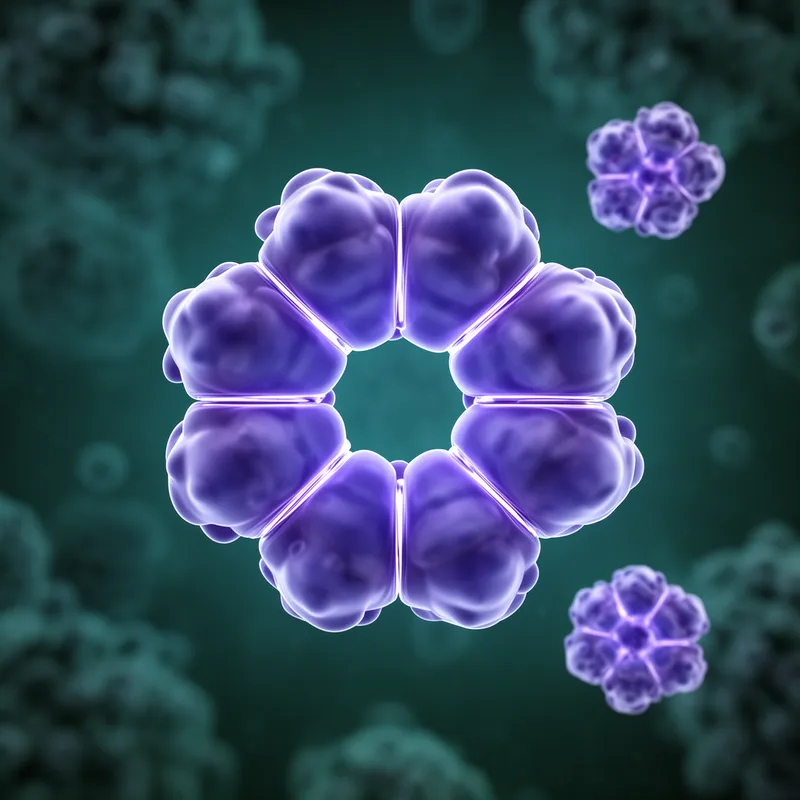
hexamer
- noun
- /ˈhɛksəˌmɜr/
- Specialized
- Clip, Clip X is a hexamer and it's an AAA.
- hexamers and pentamers
- forms a hexamer
- shows a hexamer
Examples
-
After subcutaneous injection, the acidic solution is neutralized, and insulin glargine hexamers form microprecipitates that result in the slow release of insulin glargine monomers.
Academic text (2017) -
It's another level of sophistication within this hexamer here.
-
Elisa, right that the the dominant species is a hexamer, but the reactive species is a monomer.
-
Although the same protein makes up both types of capsomer, it adopts three different shapes to form pentamers and hexamers, as shown on the right.
Academic text (2004) -
These long hexamer chains are unable to enter the circulation, thereby prolonging the absorption rate and resulting in slow and continuous release of smaller insulin monomers or dimers.
Academic text (2017) -
Although native human insulin naturally dimerizes and then further associates into hexamers in the presence of zinc, insulin degludec self-associates into stable di-hexamer complexes.
Academic text (2017) -
The research focused on how the hexamer structures interact with other molecules in the solution.
-
Scientists discovered that the hexamer of the protein was essential for its biological function.
-
In this experiment, the hexamer consists of six identical subunits working together to enhance stability.
Synonyms

 1
8.9
1
8.9

A small molecule that has a few repeated parts joined together
A group of six things or the number six
How Many Parts


Surface Forms
Morphology
hexamer = hexa + mer
The parts are Greek combining forms ('hexa-' for six and '-mer' for a unit) used in technical chemistry/biology terms and are not standalone common English words, so a B1 learner cannot reliably derive the meaning from the components.
Etymology
Hexamer comes from Greek parts hexa- 'six' and -mer 'part', the same -mer you see in polymer, so a hexamer is a molecule or structure made of six joined parts.