
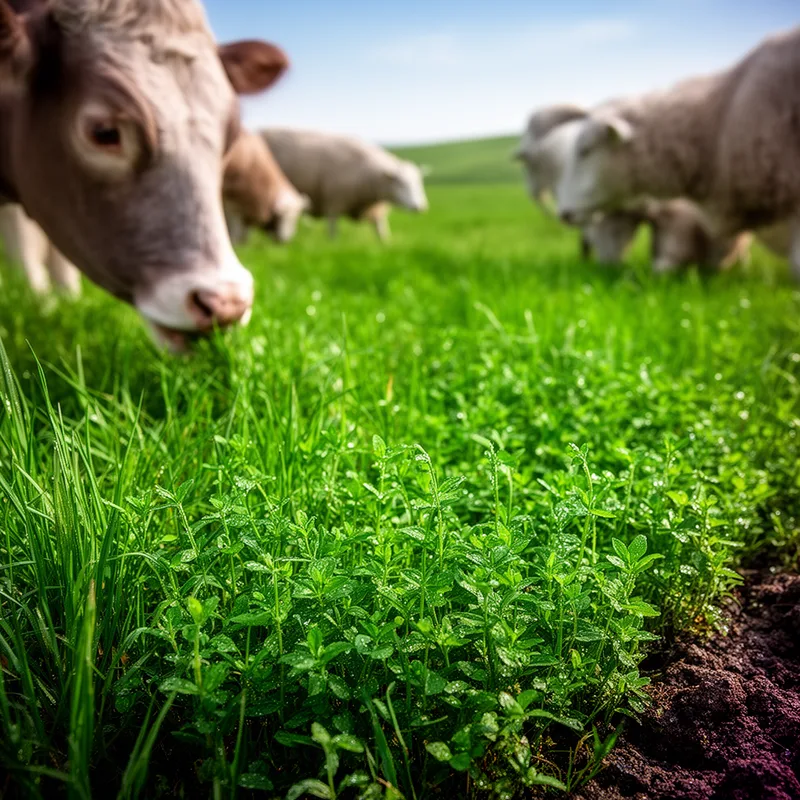
herbage
 1
8.8
1
8.8

- noun
- /ˈhɜːrbɪdʒ/
- Specialized
- L3s were recovered from herbage samples from plots 3-4 weeks after the faeces had been deposited during May-October (Ramsey et al., 2004).
Examples
-
Now add the tomato paste and the herbage:
Blog text (9) -
What is more, the timescale may be adjusted and detailed according to the herbage growth and development stage.
Academic text (2018) -
With me along the strip of herbage strewn
Fiction book (1999) -
Let's give it some herbage and let it loose in the back pasture.
Blog text (29) -
Dehydration can prevent L3s from leaving the feces and gaining contact with herbage.
Academic text (2015) -
Yeah... surely I do imbibe in copious herbage... but I don't drink alcohol, I made straight A's... and I show the utmost respect for ladies.
-
However, the occurrence of drought in grassland will be related to herbage drought resistance, the topography of the study area, and local anti-drought measures.
Academic text (2018) -
They are broken and rugged; of volcanic origin; and where the scant herbage fails, their naked sides show tawny as a lion's hide.
Blog text (22) -
Conceive a dell deep-hollowed in forest secrecy; it lies in dimness and mist; its turf is dank, its herbage pale and humid.
Academic text (1992) -
The cows grazed peacefully on the lush herbage throughout the warm summer days.
Synonyms
 102
1.4
102
1.4
Land with grass where farm animals eat
 20
2.7
20
2.7
An open area covered mainly with grass where animals live or graze
 4
4.4
4
4.4
Bulky food like grass or hay fed to horses and cattle
 3
2.5
3
2.5
Land with grass where animals like cows or sheep eat
 2
3.7
2
3.7
Land covered with grass where cows or sheep eat
 2
2.6
2
2.6
Land with grass where farm animals eat
 1
8.2
1
8.2
Land with grass that animals like cows or horses eat


 1
3.1
1
3.1
Open land with grass and wildflowers where animals graze
Surface Forms
Morphology
Etymology
The word herbage comes from the common word herb ('small green plant' or 'grass') plus the ending -age ('a group of something'). So herbage means the plants or grass in a field—the group of plants that animals can eat or graze on.