

hemoglobin
 17
4.5
17
4.5

- noun
- /ˌhɛməˈɡloʊbɪn/
- Specialized
- Hemoglobin levels are normal.
- hemoglobin concentration
- hemoglobin level
- preoperative hemoglobin
Loading YouTube…
Watch on YouTubeThe magnetic properties of the hemoglobin molecule change depending on the amount of oxygen bound to it.
- The magnetic properties of the hemoglobin molecule change depending on the amount of oxygen bound to it.
- But as days and weeks go on and you're eating or drinking too much sugar, you're going to glycate that hemoglobin.
- So you show me somebody on on their blood test that has low red blood cell count, low hemoglobin, you know, red blood cells kind of like a tennis ball.
- So it turns out the hemoglobin just blood cells, right, are highly absorbent in green light.
- Each of these variants of hemoglobin that is able to bind oxygen you can look at as a different solution to the same problem that nature faces.
- So I looked into this and leg hemoglobin.
Examples
-
Preoperative hemoglobin was defined as the last hemoglobin measurement before surgery.
Academic text (1999) -
Second, nearly half the patients did not have a postoperative hemoglobin level recorded.
Academic text (1999) -
Your hemoglobin level is a bit low.
-
The magnetic properties of the hemoglobin molecule change depending on the amount of oxygen bound to it.
-
So that hemoglobin, if it is exposed to a lot of sugar, then becomes chemically bound to the sugar.
-
Although supplementation with vitamin A increases hemoglobin in children, little attention has been paid to pregnant women.
Academic text (1994) -
Fetal hemoglobin has a greater affinity for oxygen than adult hemoglobin does.
Academic text (2013) -
Transfusions were recommended at a hemoglobin concentration below 10 g/dL based on the measured blood loss.
Academic text (1994) -
Preoperative anemia was uncommon; only 11% of the patients had a hemoglobin less than 10 g/dL.
Academic text (1999) -
A low hemoglobin count can lead to symptoms like fatigue and weakness.
Synonyms
 6
5.3
6
5.3
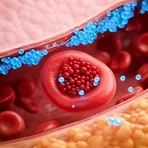
A protein in red blood cells that carries oxygen from the lungs to the body

A bright red part of blood that carries oxygen from the lungs to the body's tissues
Surface Forms
Morphology
Etymology
Hemoglobin comes from the parts haemo- 'blood' and globin from 'globule' 'small round thing', like a 'globe'. So, hemoglobin is the round protein in blood that carries oxygen to the rest of the body.