
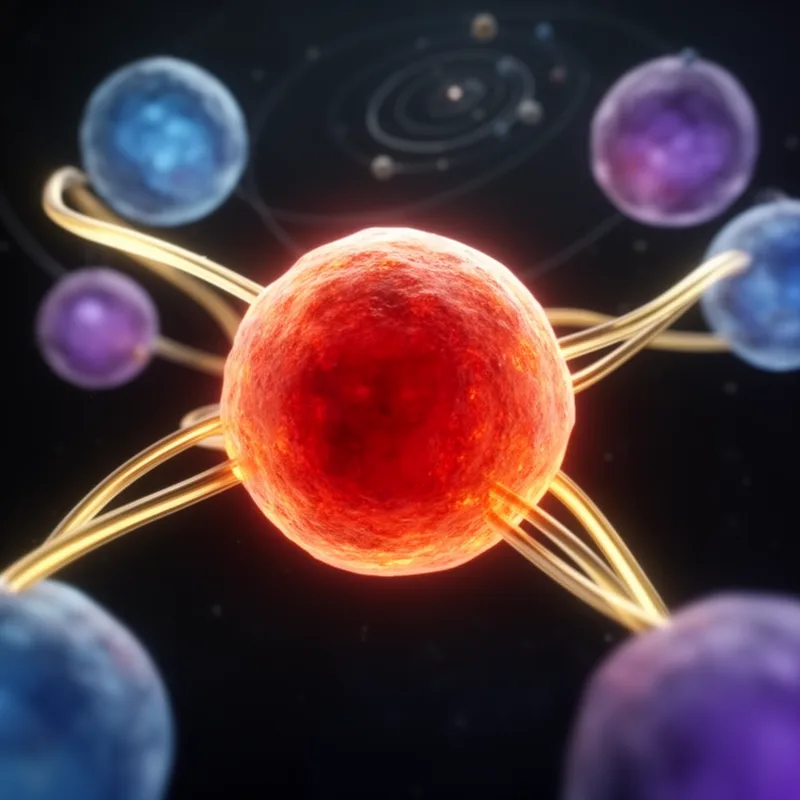
heavy particle
- noun
- /ˈhɛvi ˈpɑrtɪkl/
- Specialized
- In particle physics, protons and neutrons are examples of heavy particles that exhibit strong interactions.
Examples
-
Other heavy particles, such as neutrons, light ions (particularly carbon and neon), and pi mesons have also been used for radiation therapy.
Academic text (2002) -
"The GUT era of ancient universal history is a time of very high energies and consequently of very heavy particles.
Fiction book (1991) -
But the heavy particles drop to the ground within 24 hours.
-
Then you kind of get what you expect, that all the effects of the heavy particles turn up in couplings.
-
For this reason, neglecting heavy particles will never change our estimate of where the loop expansion breaks down.
Academic text (2018) -
Baryons are considered heavy particles because they have a mass greater than that of a proton.
-
Scientists study heavy particles to understand the fundamental forces that govern matter in the universe.
Synonyms
 5
9.6
5
9.6

A small particle made of quarks, like a proton or neutron
 4
9.9
4
9.9
A particle made of three smaller particles, like a proton or neutron, that interacts through the strong force
How Massive
- Specialized
1
8.8

- Specialized
- Specialized
447
4.2
- Specialized
Surface Forms
Morphology
The meaning (‘an elementary particle with relatively large mass’) is directly derivable from combining 'heavy' (having large mass) with 'particle' (a tiny physical bit). This is a regular adjective+noun compositional pattern found across languages, so a B1 learner who knows both constituents will readily infer the MWE meaning.
Etymology
Heavy particle is a physics name that literally labels a heavy tiny particle that has more mass than many others. Because these heavier particles, for example a proton or neutron, feel the strong forces in atoms, the name came to mean 'a particle with mass equal to or greater than a proton that takes part in strong interactions'.