
hard bop


 1
7.9
1
7.9
- noun
- /hɑrd bɑp/
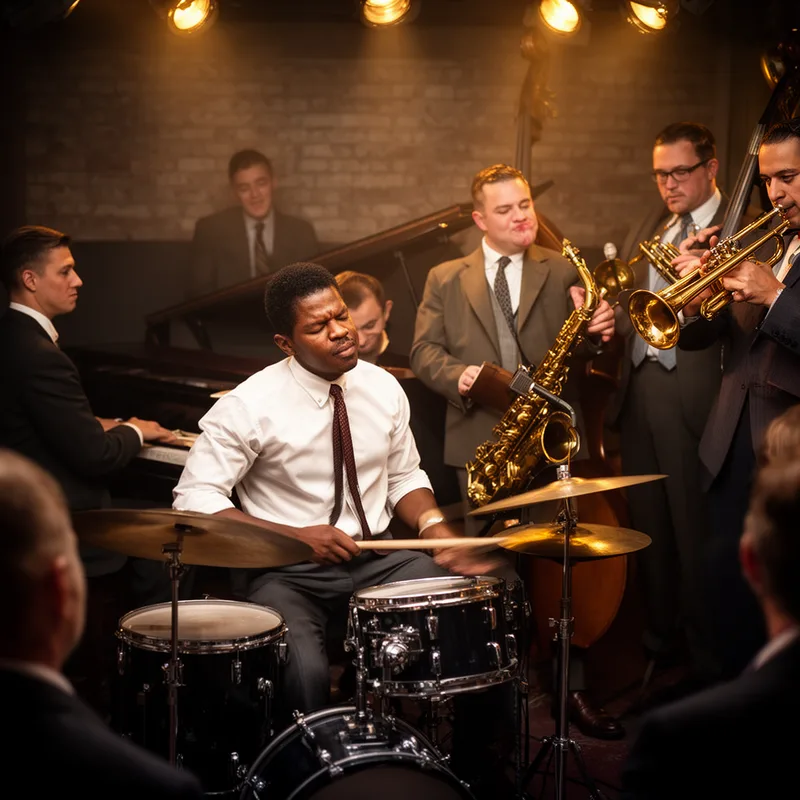
- The vibrant sound of hard bop often featured improvisation that highlighted the musicians' emotional expression.
- hard bop and bebop
Examples
-
In fact, when hard bop and bebop players of the 1940s and 1950s heard this progression, they may have been "thinking" scale or mode as they improvised.
Academic text (1991) -
In the late 1950s and early 1960s, a movement emerged that encouraged a less bounded style of jazz improvisation in contrast to the more restricted styles of bebop and hard bop (Sansom, 2001).
Academic text (2013) -
Yeah, sure, it was smooth jazz, not hard bop, but the vehicle got me to pay attention with fine acting.
Blog text (29) -
It is the contrast beyond the hard-bop and post-bop accoutrements and the old-fashioned core of his solo that, for me, brings out the strength of the lyrics.
Academic text (2014) -
The ii-V7-I progression can be heard in the hard bop and bebop improvisations of Clifford Brown, Fats Navarro, and Charlie Parker.
Academic text (1991) -
Many famous musicians like Miles Davis and Art Blakey were known for their contributions to hard bop jazz.
-
During the late 1950s, hard bop became popular due to its soulful rhythms and strong blues influences.
Synonyms
 273
1.0
273
1.0
A lively music style with a strong beat where players make up parts while playing
How Complex

Surface Forms
Morphology
The meaning is compositionally derived: 'hard' modifies 'bop', so a learner who knows 'bop' (a style of jazz) and 'hard' can infer a stronger/more forceful or earthier variety of bop. This adjective+noun pattern is regular and cross-linguistically common, so a B1 learner knowing the constituents can reasonably deduce the MWE meaning.
Etymology
Hard bop joins hard, meaning strong or tough, and bop, from 'bebop', an earlier jazz style. In the 1950s musicians added more blues and gospel feeling to 'bebop', making a tougher, more soulful sound, so people called it hard bop.