

bop
 6
8.4
6
8.4

- noun
- /bɑp/
- In the late 1950s and early 1960s, a movement emerged that encouraged a less bounded style of jazz improvisation in contrast to the more restricted styles of bebop and hard bop (Sansom, 2001).
- hard bop
- bop and bebop
- post-bop
Loading YouTube…
Watch on YouTubeAnd there's some cool like post bop stuff that really gets into, you know, intense compositions.
- And there's some cool like post bop stuff that really gets into, you know, intense compositions.
Examples
-
The ii-V7-I progression can be heard in the hard bop and bebop improvisations of Clifford Brown, Fats Navarro, and Charlie Parker.
Academic text (1991) -
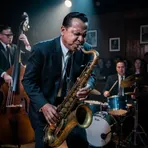
The new music genre, bop, emerged from late-night jam sessions in 1940s New York clubs.
-
Bop musicians were no exception.
Academic text (2014) -
Ella had come from the Swing Era and become proficient in bop.
Academic text (2014) -
In an Igloo has all the makings of early bop, and it wouldn't be for another year.
Blog text (15) -
Dizzy Gillespie showcased his talent in bop with innovative rhythms and spontaneous improvisation.
-
Many musicians consider bop a significant evolution of jazz due to its fast tempo and intricate melodies.
Synonyms
 273
1.0
273
1.0
A lively music style with a strong beat where players make up parts while playing
 16
8.2
16
8.2
A fast, complex style of jazz where musicians make up music as they play
 3
3.6
3
3.6
A style of jazz with complex chords and rhythms where musicians make up music as they play
Compounds


Surface Forms
Etymology
Bop as a jazz noun comes from the name bebop, a 1940s style where musicians used short 'be-bop' phrases and fast improvisation to create a new, energetic sound. That's why bop refers to that early, rapid form of jazz.