

halftone
 1
7.4
1
7.4

- noun
- /ˈhæfˌtoʊn/
- Specialized
- Comparison of the halftones on the proof with those on the printed sheet is a good method for control.
- halftone dots
- halftone printing
- halftone screen
Loading YouTube…
Watch on YouTubeThe picture was a halftone cut of a hideous stone image, almost identical with that which La Grasse had found in the swamp.
- The picture was a halftone cut of a hideous stone image, almost identical with that which La Grasse had found in the swamp.
Examples
-
The facsimile image is much like the halftones that newspapers use.
Academic text (1990) -
Gray-scale printers have the advantage of not requiring halftone patterns to produce a gray scale.
Academic text (1992) -
You can actually see the halftone patterns of the colour plates.
-
The halftone printing press reproduction used here cannot really show the quality of the original photo.
Academic text (1992) -
In commercial printing, these patterns, or halftone "dots," are quite small: there are typically 120 to 175 dots.
Academic text (1992) -
Any proofing system intended for commercial printing must use halftones because printing presses use halftones, as discussed earlier.
Academic text (1992) -
The photograph was printed as a halftone, allowing for smooth gradients in the image.
-
In graphic design, artists often utilize halftone techniques to create depth and texture in their prints.
-
Many modern magazines use halftone images to reproduce photographs with varying shades of grey.
Synonyms

A printed picture made of small dots that show light and dark

A printing method using many small dots to make shades

A way of making full-color images using four color inks
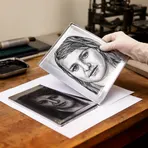
A metal plate made using a photograph to print clear pictures
Compounds
How Solid
- US
2
3.0

- Specialized
- Specialized
- Specialized
1
7.4
Surface Forms
Morphology
Etymology
Halftone is made of half ('part' or 'between') and tone ('shade'). Printers use tiny dots to make the middle shades between black and white, so a halftone is the printed image or method that creates smooth tones.