
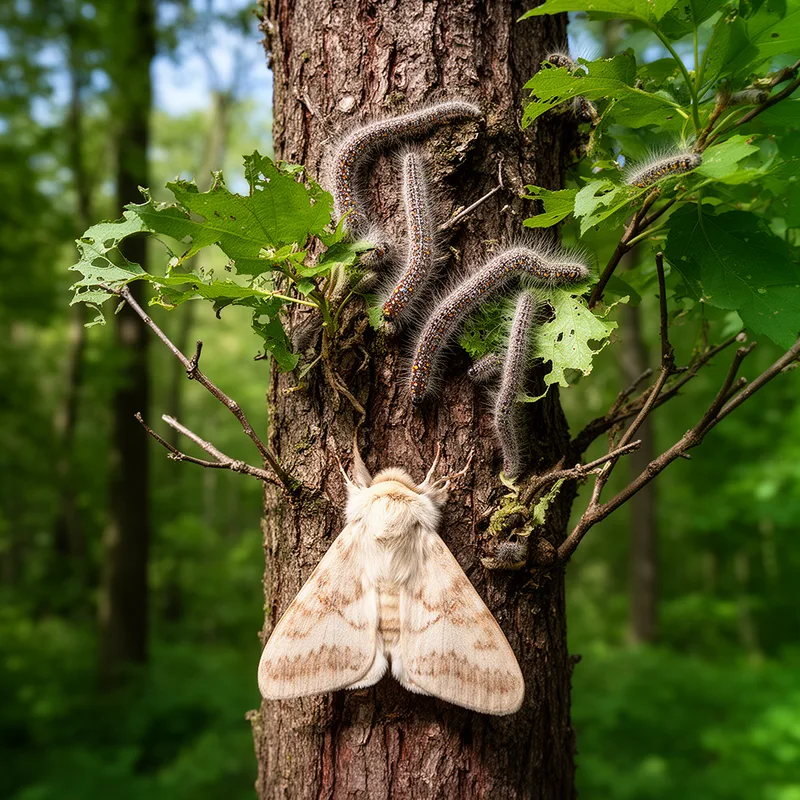
gypsy moth
 1
7.4
1
7.4

- noun
- /ˈdʒɪpsi mɔθ/
- NSFW
- However, some pests, such as the gypsy moth (Lymantria dispar), have as many as 100 natural enemies (Pimentel 1988).
- Asian gypsy moth
Loading YouTube…
Watch on YouTubeNow there are some pests that attack cedar trees like you like coddling moths or gypsy moths.
- Now there are some pests that attack cedar trees like you like coddling moths or gypsy moths.
Examples
-
Thorpe not only researches gypsy moths, he also runs a program to control them at BARC.
Academic text (2003) -
Because even a small release of a genetically modified organism can cause as much trouble as the gypsy moths have caused, professional supervision would be required even for small releases.
Academic text (1992) -
Do they know about gypsy moths?
-
In the eastern United States, however, with ample food and no natural enemies, the gypsy moth prospered.
Academic text (1992) -
They are seeking a way to grow the virus in a lab instead of in live gypsy moth caterpillars.
Academic text (2003) -
Scientists fear that this species could cause vastly more damage than the European gypsy moth, which already defoliates 1.5 million hectares of forest per year in North America.
Academic text (2004) -
In 1889, twenty years after Trouvelot's moths escaped, Medford experienced the first gypsy moth infestation in the United States.
Academic text (1992) -
The gypsy moth's larvae can defoliate entire forests, causing severe damage to oak trees.
-
Since arriving from Europe, the gypsy moth has become a major pest in many North American states.
-
In regions where the gypsy moth thrives, trees often lose their leaves, affecting the ecosystem.
Synonyms
A moth that eats the leaves of many trees and damages forests and urban trees in North America
Antonyms

Surface Forms
Morphology
The compound is compositionally clear: a B1 learner who knows 'gypsy' and 'moth' will understand this denotes a kind/kind of moth. However, the specific referent (the species Lymantria dispar) and its important encyclopedic sense as an introduced, tree‑defoliating pest are not predictable from the constituents, and 'Gypsy' functions as a historical/name modifier rather than a literal descriptor, so full meaning requires extra knowledge.
Etymology
Gypsy moth may get its name from the 1800s, when moths brought from Europe escaped from a man who bred them and began to spread through local woods. People called them gypsies because they seemed to 'move from place to place', so today gypsy moth means the moth that eats leaves and can damage trees.