
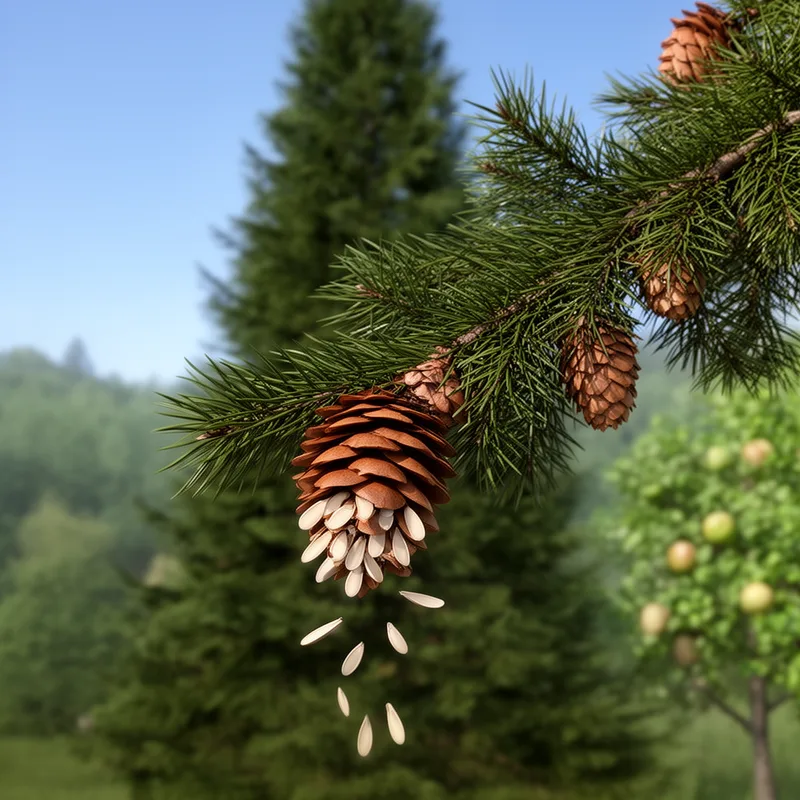
gymnospermous tree
- noun
- /ˌdʒɪm.nəˈspɜr.məs tri/
- Specialized
- Unlike flowering plants, a gymnospermous tree produces seeds in cones rather than fruits.
Examples
-
The pine is a well-known example of a gymnospermous tree found in temperate forests.
-
Many gymnospermous trees are evergreens, retaining their needles throughout the year.
-
The gymnospermous tree stood tall in the forest.
-
Many gymnospermous trees thrive in cold climates.
-
Many gymnospermous trees are evergreens, retaining their needles throughout the year.
-
The pine is a well-known example of a gymnospermous tree found in temperate forests.
-
Unlike flowering plants, a gymnospermous tree produces seeds in cones rather than fruits.
Surface Forms
Morphology
The meaning 'a tree with exposed (uncovered) seeds' is directly derivable from combining 'gymnospermous' (pertaining to plants with exposed seeds) with 'tree' (a tall perennial plant). This is a straightforward adjective + noun composition following regular English patterns, so a B1 learner who knows both constituents would understand the MWE despite its technical register.
Etymology
Gymnospermous tree The name gymnospermous tree comes from old Greek parts gymno- and -sperm, meaning 'naked' and 'seed'. So, the image of 'naked seeds' sitting on cones, not inside a fruit, helps you remember it means a tree whose seeds are 'not inside a fruit'.

