

gray poplar
- noun
- /ɡreɪ ˈpɑːplər/
- US
- The leaves of the gray poplar are green on top and grayish underneath, making the tree easy to identify.
Examples
-
The gray poplar is often planted in parks for its rapid growth and attractive foliage.
-
Many gray poplars can be found along the riverbank.
-
Botanists have noted that the gray poplar can easily hybridize with other poplar species.
-
The gray poplar grows rapidly in suitable climates.
-
The gray poplar is prized for its quick growth and distinctive leaves, making it a popular choice for landscaping.
-
On a summer afternoon, the tall gray poplar provided much-needed shade near the walking path.
-
In Europe, the gray poplar is commonly found in wetlands, thriving in moist soil conditions.
Synonyms

 9
4.4
9
4.4

A tall tree with light wood and small hanging flowers that grows in cool areas
 2
3.0
2
3.0
A tall tree that grows quickly with light wood and long hanging catkins
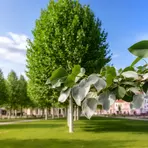
A large fast-growing poplar tree with leaves grey underneath native to Europe

A group of trees like poplars and aspens that lose their leaves in winter
Surface Forms
Morphology
This is a straightforward adjectival-noun combination: 'gray' (a colour) + 'poplar' (a tree), so a learner who knows both words can infer it denotes a kind of poplar with grayish characteristics (e.g., leaf undersides). Such descriptive plant names follow common compositional patterns across languages and show no idiomatic or metaphorical shift.
Etymology
Gray poplar probably gets its name from the tree's look: the leaves are green on top but pale and gray underneath, so when the wind turns them the whole tree can look gray. That's why gray and poplar together mean 'a poplar with gray leaves'.