
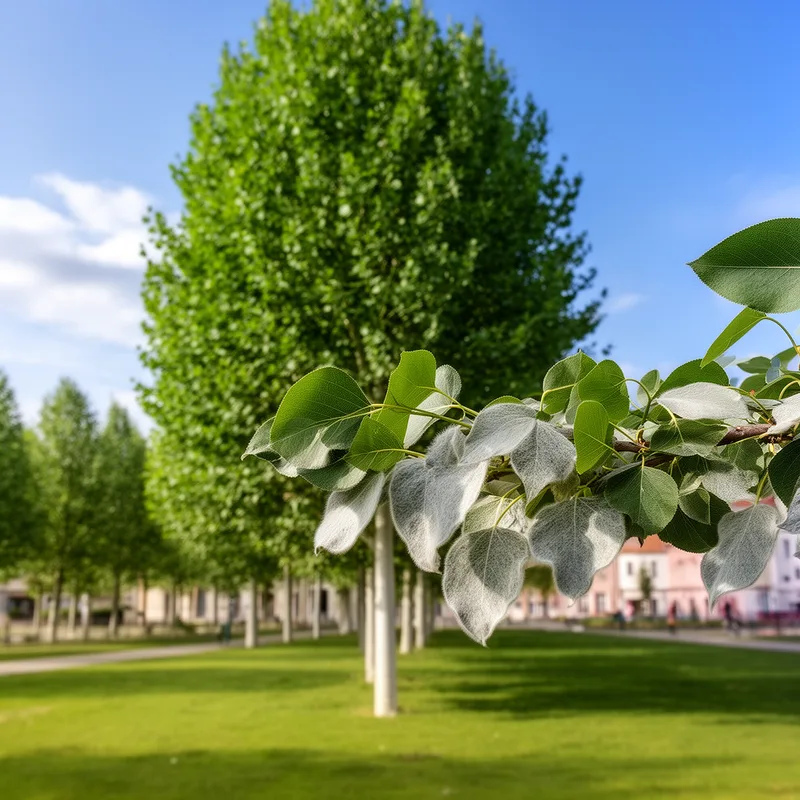
Populus canescens
- noun
- Specialized
- The leaves of Populus canescens are easily identified by their grey undersides and wavy edges.
Examples
-
Several Populus canescens were planted to provide shade along the avenue.
-
The Populus canescens thrives in wet soil.
-
Scientists studied the growth patterns of Populus canescens in different soil types.
-
Have you seen a Populus canescens tree before?
-
The leaves of Populus canescens turn a beautiful shade of silver in the sunlight.
-
In parks across Europe, Populus canescens trees provide excellent shade during the summer.
-
Many landscapers choose Populus canescens for faster growth and attractive foliage.
Synonyms

A tall tree with leaves green on top and gray underneath
How Fast


Surface Forms
Morphology
Populus + canescens
The name is compositional as a botanical binomial (genus + specific epithet), so if a learner knew 'Populus' (poplar) and the Latin-derived 'canescens' (greyish/hoary) they could infer it denotes a greyish poplar species. However, 'canescens' is a technical/Latin term not found in the learner-facing dictionary entry and is unlikely to be known by an average B1 learner, so the meaning is only partially transparent.
Etymology
Populus canescens comes from Latin words: Populus means 'poplar' and canescens means 'turning grey'. That's why the name fits a poplar whose leaves are grey underneath.