

gravitational theory


 1
4.8
1
4.8
- noun
- /ˌɡrævɪˈteɪʃənl ˈθɪəri/
- Specialized
- Scientists often rely on gravitational theory to explain the orbits of planets around the sun.
Examples
-
According to gravitational theory, objects with greater masses will exert a stronger pull on each other.
-
At the heart of gravitational theory is a concept called the Einstein equivalence principle, which modernizes Newton's postulate of the equivalence of gravitational and inertial mass.
Academic text (1999) -
Doesn't gravitational theory indicate an attraction between mass?
Blog text (19) -
The gravitational theory developed by Newton laid the groundwork for our understanding of how forces interact in space.
Synonyms
 4
3.7
4
3.7
An idea that all objects pull on each other, more when they are heavier and closer

A scientific idea about how objects pull each other, with larger objects pulling more and pull weakening with distance
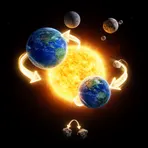
A scientific theory saying any two objects pull each other more if heavier and less as they get farther apart

A law saying every two objects pull each other with force that grows with mass and decreases with distance

All objects attract each other with a force that grows with mass and falls with distance
How Accurate
- Specialized
3
6.8

- Specialized
1
4.8
138
6.1
288
4.8
Surface Forms
Morphology
The meaning is directly and compositionally derived from 'gravitational' (pertaining to gravity) + 'theory' (a set of ideas explaining facts); together they naturally mean a theory about gravity. This is a cross-linguistically common nominal composition and follows transparent scientific naming patterns that a B1 learner who knows the constituents would readily understand.
Etymology
Gravitational theory comes from the simple image that gravitational means 'pulling' and theory is an idea that explains that pull. So gravitational theory is the scientific idea that objects with mass 'pull toward each other', which explains why things fall and why planets move.