
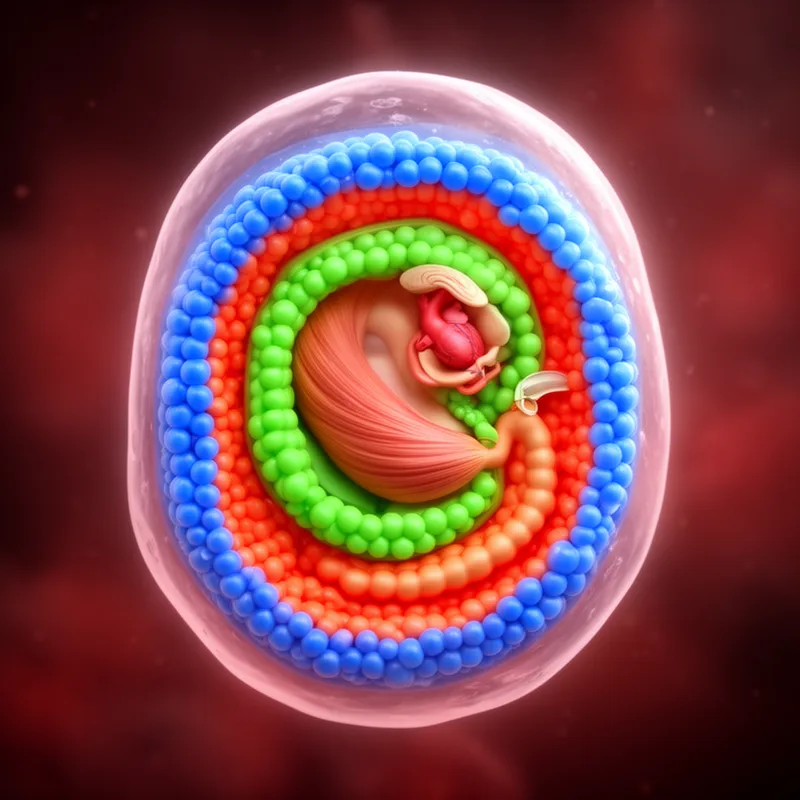
germ layer
- noun
- /dʒɜrm ˈleɪər/
- Specialized
- Diagram depicts the differentiation pathways that adult mouse utricular stem cells follow as they become cell types from the three germ layers, including hair cells and neurons.
- the three germ layers
Examples
-
Some organisms develop just two layers (ectoderm and endoderm), whereas more complex organisms will develop all three germ layers.
Academic text (2002) -
Much of our elemental architecture is the same, bred deep in the germ layers of a body plan more ancient than flowers.
Academic text (2007) -
And what happens is the cells flow into the anterior, OK and you get then the formation of the germ layers with gastrulation.
-
Well-differentiated tissues of all three germ layers that were equivalent to the tissues of controls of the same age were observed in histological sections.
Academic text (1999) -
Several years ago, a group of biology students developed the mnemonic device IN SMERC RED as an aid to remembering the organ systems that the embryonic germ layers give rise to during embryonic development.
Academic text (2002) -
During embryonic development, all organs originate from one of the three primary germ layers.
-
In the early stages of growth, the embryo consists of three germ layers that give rise to various tissues.
-
The ectoderm, mesoderm, and endoderm are the three distinct germ layers formed in an embryo.
Synonyms
 1
5.4
1
5.4

Tissue in an embryo that develops into organs
A layer of cells inside an embryo that makes early body tissues
Surface Forms
Morphology
The noun combines 'germ' (in the germinal/embryo sense) with 'layer', so a learner who knows the constituents can infer it denotes a layer related to early development or the embryo. However, the precise technical sense (the three specific primary cell layers and their developmental roles) is specialized and not fully predictable to a B1 learner without domain knowledge, so it is only partially transparent.
Etymology
Germ layer uses germ in the old sense of a tiny 'beginning' or 'seed' and layer to mean a sheet or level. These first sheets of cells in an embryo act like little seeds that later grow into the body's tissues and organs, so the name helps explain their role.