
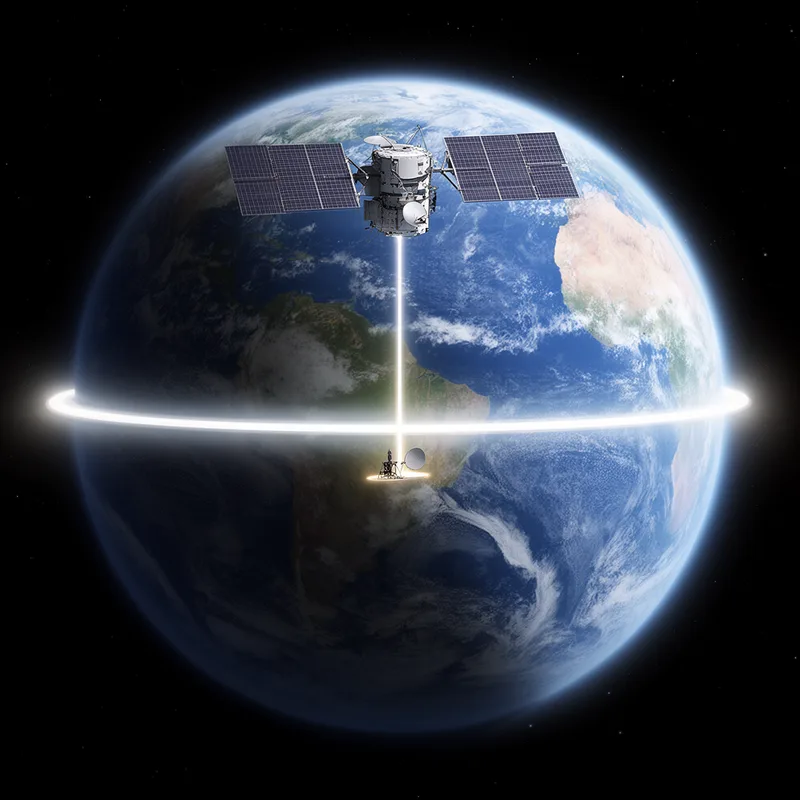
geostationary orbit


 1
6.1
1
6.1
- noun
- /ˌdʒiːoʊˈsteɪʃənˌɛri ˈɔːrbɪt/
- Specialized
- Television signals are transmitted from satellites in geostationary orbit, which matches the Earth's rotation at an altitude of 22,300 miles.
- launch to geostationary orbit
Examples
-
Satellites in geostationary orbit remain fixed above the same point on the equator, allowing for constant communication signals.
-
I did not discover the geostationary orbit, even though people are now naming it after me.
Academic text (2000) -
And so this is geostationary orbit, so we just call it Geo.
-
It's parked itseIf in a geostationary orbit directIy over London.
-
So satellites in geostationary orbit, which is a very high altitude orbit that matches the rotation of the Earth, transmits TV signals down to the Earth.
-
In the fall of 2012, the communications satellite EchoStar XVI will launch into geostationary orbit with the disc mounted to its anti-earth deck.
Blog text (32) -
For those wondering, Echostar XVI will be in geostationary orbit, so won't be subject to atmospheric friction like the ISS is.
Blog text (7) -
What I did was to point out that (a) artificial satellites, with their line-of-sight view of enormous areas of the Earth, could act as wonderful relay stations, and (b) the obvious location for such relays was in geostationary orbit, where they would stay fixed over the same spot on the planet and therefore, unlike all other celestial bodies, would remain motionless in the sky.
Academic text (2000) -
A study prepared in mid-1995 by the U.S. Department of Transportation's industry-led Commercial Space Transportation Advisory Committee predicts that there will be between twenty-six and thirty-three commercial satellite launches to geostationary orbit in 1997.
Academic text (1996) -
The weather satellite was launched to achieve a geostationary orbit and provide real-time updates for the region below.
Synonyms
 3
6.9
3
6.9
A path around Earth where a satellite goes once every 24 hours and stays above the same place each day
How Wide
- Specialized
1
6.1

- Specialized
4
3.5
- Specialized
1
3.2
- Specialized
11
2.7
- Specialized
1
4.6
Surface Forms
Morphology
The meaning is directly compositional: 'geostationary' (fixed relative to the Earth's surface) combined with 'orbit' (a path around the Earth) yields an orbit that remains above the same point, matching the given definition. The compound uses transparent technical morphology (geo- + stationary) and equivalent terms exist in many languages, so a learner who knows both constituents can infer the MWE meaning.
Etymology
The noun geostationary orbit comes from geo ('earth') and stationary ('not moving'), creating the image of something fixed above the planet. A satellite in this orbit moves with the Earth so it appears to 'stay' above the same spot on the 'equator', which is why it is used for steady TV and weather signals.