

geosphere
- noun
- /ˈdʒiːəˌsfɪr/
- Specialized
- Pierre Teilhard de Chardin noted that, as the molten Earth solidified, it formed a geosphere.
Examples
-
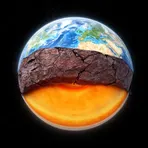
The geosphere includes the Earth's crust and outer mantle, which are vital for understanding geological processes.
-
Scientists study the geosphere to learn how the planet's solid structure influences climate change.
-
The soil data are from the International Geosphere-Biosphere Programme Data and Information System.
Academic text (2004) -
The environmental sciences, including geography, employ imaging technologies such as sonar to screen structures of earth, rock, and water and offer fine-grained maps of phenomena ranging from the geosphere to the atmosphere.
Academic text (2018) -
Geologists often explore the geosphere to find natural resources like minerals and fossil fuels.
Synonyms
 1
7.6
1
7.6

The hard outer part of the Earth made of the crust and the top of the mantle
How Deep

Surface Forms
Morphology
Etymology
Geosphere comes from the Greek parts geo meaning 'earth' and sphere meaning 'ball' or 'round object', as in geography or geology. So the geosphere is the Earth's 'ball' of solid rock, the ground and deep layers, not the air or the water.