
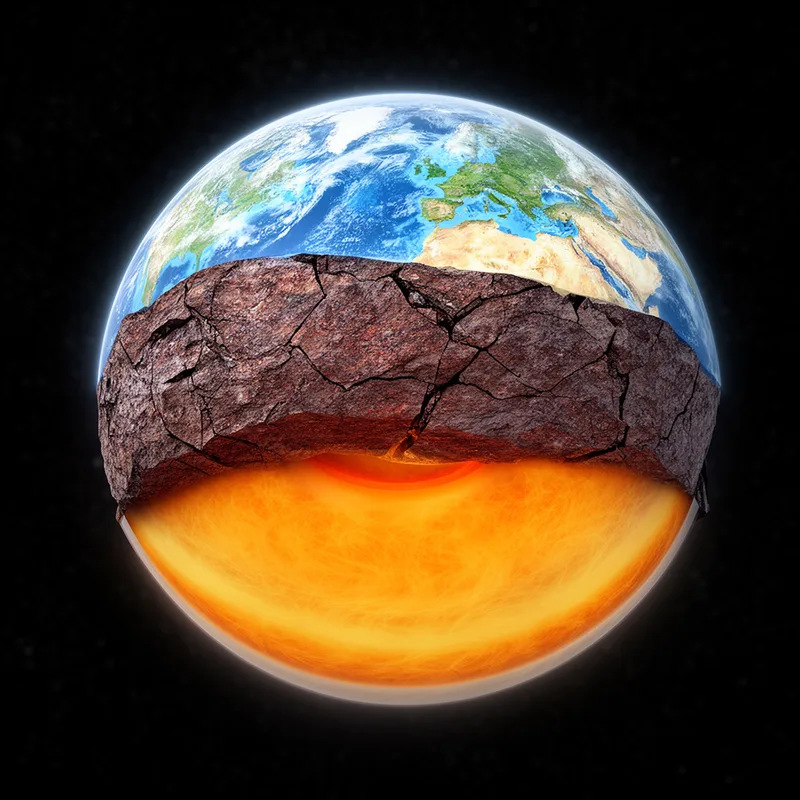
lithosphere
 1
7.6
1
7.6

- noun
- /ˈlɪθəˌsfɪr/
- Specialized
- Until 20 million to 30 million years ago, the African and Arabian plates were a single massive block of our planet's lithosphere.
Loading YouTube…
Watch on YouTubeIt also potentially stripped off the upper mantle, the upper lithosphere of the Earth, and that could have been used.
- It also potentially stripped off the upper mantle, the upper lithosphere of the Earth, and that could have been used.
Examples
-
In plate tectonics, the rigid outer layer, or lithosphere, is broken up into sections, the plates.
Academic text (1995) -
As the diapir continues to push up on the lithosphere, the lithosphere pushes down on the diapir.
Academic text (1995) -
The soil system is the third largest reservoir of C, next only to the lithosphere and oceans.
Academic text (2007) -
The answer could be the thickness of the lithosphere.
Academic text (1995) -
As the ice expands, it pressurizes the lithosphere.
-
If the lithosphere is thin enough, it cracks, and fault lines radiate out from the dome's center.
Academic text (1995) -
On the Earth, the lithosphere under the continents is several times this thickness, but it is thinner under the oceans.
Academic text (1995) -
When the diapir reaches the top of the mantle, it bumps up against the lithosphere, the solid shell of rock that forms the surface of the planet.
Academic text (1995) -
The tunnel leads to a vault 1.6 kilometers inside the Earth's lithosphere and is encased in a double layer of Inconel 625.
-
Like an egg, Earth possesses a relatively rigid outer shell, known as the lithosphere.
Surface Forms
Morphology
Etymology
The word lithosphere comes from the parts litho- 'stone' and -sphere 'ball' or 'layer around the Earth'. So the lithosphere is the Earth's hard, rocky outer layer, the 'stone' shell made of the crust and upper mantle where tectonic plates move.