
geopolymerization
- noun
- /ˌdʒiːoʊˌpɒlɪməˈraɪzeɪʃən/
- Specialized
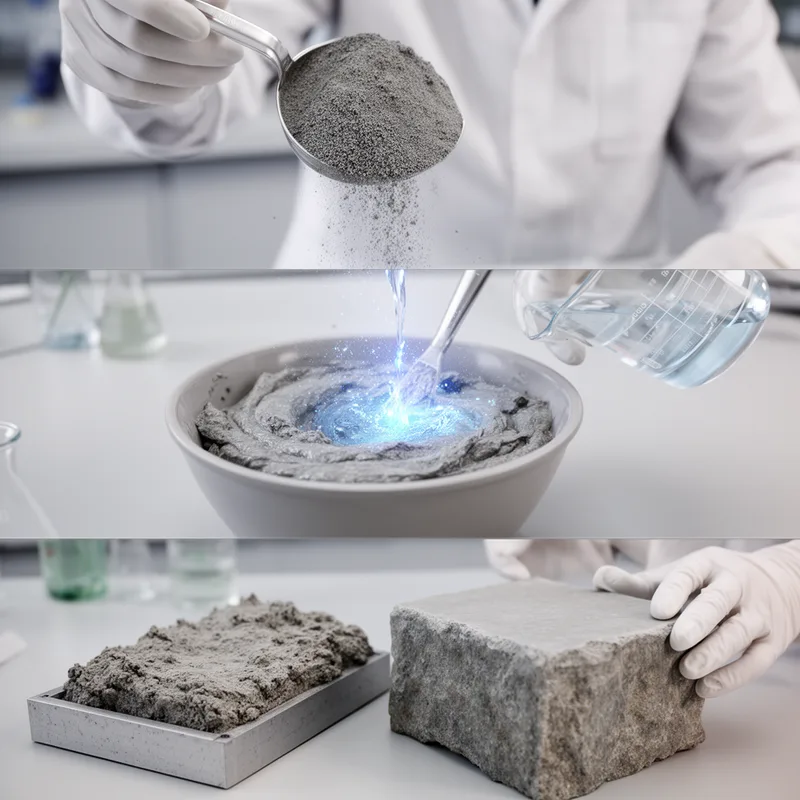
- The process of geopolymerization occurs when aluminosilicate powders mix with alkaline solutions to create durable stone-like materials.
- degree of geopolymerization
- geopolymerization process
- geopolymerization reactions
Examples
-
The combination of aluminum into the silicate backbone during geopolymerization leads to higher compressive strength.
Academic text (2017) -
In a comprehensive study by Vafaei et al., the potential of waste-glass powder for geopolymerization was investigated.
Academic text (2018) -
This leads to an increase in the pores between new phases created during the geopolymerization.
Academic text (2017) -
The quantity of the aluminosilicate gel formed is dependent on the degree of geopolymerization.
Academic text (2017) -
The mesoporosity of fly-ash-based geopolymer increases with its degree of geopolymerization.
Academic text (2017) -
In contrast, the lack of aluminum amalgamation with silicates results in a lower degree of geopolymerization and, hence, lower compressive strength.
Academic text (2017) -
The four key elements in geopolymerization—Si, Al, Ca, and Fe—are displayed as green, red, blue, and purple, respectively.
Academic text (2017) -
In addition, the presence of reactive aluminium-silicate bonds in the 800 to 1000 cm-1 range after geopolymerization is a clear indication of a high degree of geopolymerization.
Academic text (2017) -
In this study, both fly ashes had approximately 40 to 45% of aluminum in octahedral coordination, with similar quantities converted to tetrahedral coordination during geopolymerization (25 to 30%) (Table 4).
Academic text (2017) -
The microstructural and pore-structural changes with the degree of geopolymerization are assessed using state-of-the-art techniques and then correlated with the compressive strength of the final geopolymer produced.
Academic text (2017)
How Complete


Surface Forms
Morphology
geopolymerization = polymerization (opaque) = geo + polymer + ization
Although the word is formally geo- plus polymerization, the chemistry term is specialized and its meaning is not easily recoverable for an average learner.
Etymology
Geopolymerization begins with geo- meaning 'earth' (as in geography) and contains polymer meaning 'many parts joined' (think polygon or polyester). So geopolymerization is the -ization 'process' of turning earth materials into a hard, stone-like material.