
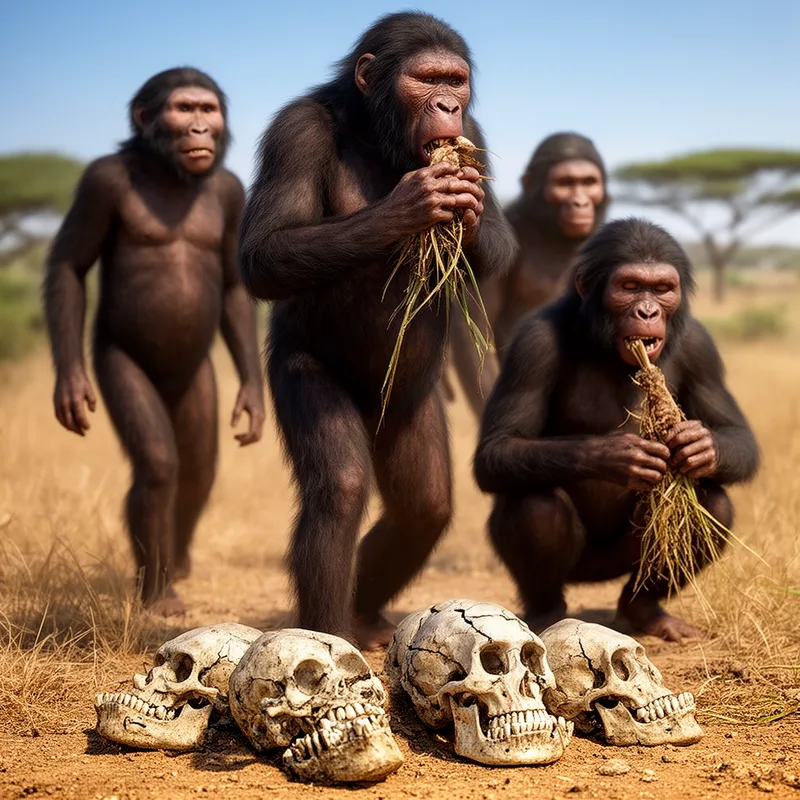
genus Paranthropus
- noun
- /ˈdʒɛnəs pəˈrænθrəpəs/
- Archaic
- Research suggests that members of the genus Paranthropus had powerful jaws adapted for chewing tough vegetation.
Examples
-
The genus Paranthropus includes several species of robust hominins.
-
Fossils classified as genus Paranthropus provide important evidence for understanding human evolution.
-
Many paleoanthropologists now prefer to refer to Australopithecus robustus rather than genus Paranthropus.
-
The genus Paranthropus existed approximately 2.7 to 1.2 million years ago.
-
Many scientists believe that several fossils belong to the genus Paranthropus due to their distinctive traits.
-
The genus Paranthropus is known for its robust skull structure and large teeth, adaptations for a specific diet.
-
Researchers are studying the genus Paranthropus to better understand the evolution of human-like species.
Synonyms


 1
9.9
1
9.9
An extinct early human relative that lived in Africa long ago
Surface Forms
Morphology
The phrase 'genus Paranthropus' is compositionally transparent: it denotes the taxonomic rank (genus) called Paranthropus, following the common 'rank + name' pattern in biology. A B1 learner who knows 'genus' (a biological rank) and 'Paranthropus' (a hominid genus) can directly infer this meaning; taxonomic naming conventions are cross-linguistically familiar, increasing transparency.
Etymology
Genus Paranthropus comes from old Greek words: para- 'beside' and anthropus 'human'. Scientists used it because they thought these fossils were a side branch 'beside' humans, so the name now means an extinct group of human-like ancestors.